
Why the Future of Collections Starts Before the First Missed Payment
Collections tools all assume the customer has already missed a payment. Here's what changes when protection is in place before the life event — and what early SymendPrevent results show.

Only 28% of US workers believe it's a good time to find a quality job — a collapse from 70% in mid-2022, according to Gallup. In Canada, 85% feel living paycheque to paycheque is the new norm, up from 60% a year earlier (H&R Block). Across the Atlantic, nearly four in five UK workers fear losing their job in 2026 (MyPerfectCV).
None of this is a story about financial irresponsibility. It's a story about exposure. Income shocks — job loss, illness, injury — are arriving faster than household protection can absorb them. Only 18% of Americans carry income protection, while 46% say they need it (LIMRA). That gap has a downstream consequence every enterprise that bills a consumer monthly already sees on its own dashboards. This post looks at how enterprises are starting to use behavioral science to prevent delinquency rather than only cure it — and what the earliest market results show.
Reactive collections is a design choice, not a law of nature
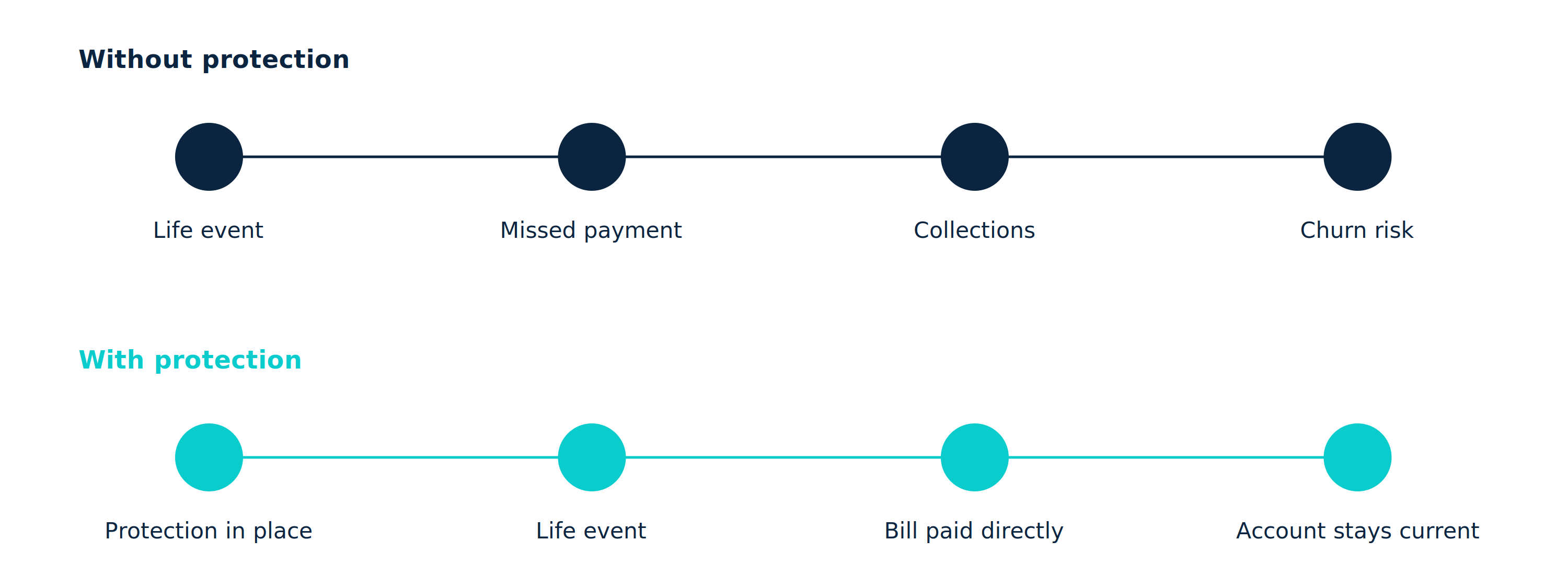
Almost every tool in the modern collections stack assumes the same starting condition: the customer has already missed a payment. The account appears in a queue, a treatment strategy fires, and the work of recovery begins.
By that point, the odds have already moved against everyone involved. Financial stress narrows attention and pushes people toward avoidance — the behavioral pattern that turns one missed bill into three unopened emails. The customer's capacity to pay has fallen and their readiness to act has fallen with it. The brand relationship has taken its first hit. And the cost to collect has already started climbing.
The aggregate evidence that reactive-only isn't holding is not subtle. US utility debt is on track to reach roughly $25 billion, with one in six households behind on payments (NEADA). Credit card charge-offs in the US sit at a 13-year high. These are not the numbers of an industry that lacks recovery capability. They're the numbers of an industry that only gets to act after the damage is done.
"Customers hit a life event, miss a payment, and churn. It's a failure of product design."
— Hanif Joshaghani, Co-Founder & CEO, SymendThat framing matters, because a failure of product design is fixable. A cost of doing business is not.
How behavioral science prevents delinquency before it starts
Behavioral science prevents delinquency by identifying the signals that precede a missed payment — financial stress, reduced engagement, avoidance behaviour — and using them to time an offer of support for the moment a customer is most likely to accept it. Protection put in place while an account is current means a life event no longer has to become a delinquency.
This is the same discipline that has been improving recovery for years, pointed upstream. Behavioral science has already established that the timing, channel, and framing of a message determine whether a customer engages or ignores — the message content is only part of the equation. Prevention applies those principles earlier in the lifecycle, when trust is intact and the customer still has room to act.
SymendPrevent is what that looks like in practice. It's bill payment protection covering up to six months of a customer's bills in the event of job loss, hospitalization, critical illness, or death. When a covered event occurs, the claim pays the customer's bill directly to the provider. The account stays current. The delinquency-to-churn sequence never starts.
The behavioral work sits in the distribution. Coverage is not restricted to customers who have been past due — it can be offered across the base, to customers in good standing who have never missed a payment. What behavioral science determines is who to approach, when, and through which channel, using the same capacity-to-pay and readiness-to-act segmentation that drives Symend's engagement journeys. Coverage itself is provided by licensed insurer Walnut Insurance, Symend's partner on the product; Symend does not underwrite or issue coverage. Symend manages the engagement journey end to end, from identification through enrollment, claims, and customer support — at zero cost, zero risk, and zero IT lift for the enterprise.
What the early results show
SymendPrevent is live in early commercial deployment, and the initial numbers are worth reading closely — not least because they were produced through a single, constrained engagement channel.
Enrolled customers show a 60%+ reduction in churn rate. Offer open rates exceed 50%, materially above insurance industry benchmarks. Both figures point to the same conclusion: the constraint on protection products was never consumer demand. It was reach and timing. Traditional insurance distribution has never had access to the moment a customer actively recognizes their own exposure.
reduction in churn rate among enrolled SymendPrevent customers — with offer open rates above 50%, materially outperforming insurance industry benchmarks.
The third result may be the most strategically interesting. Adoption is highest among high-ARPU customers, who consistently enroll in the highest available coverage tiers. These are the accounts with the most revenue at risk from a single churn event, and historically the hardest to win back once they've gone past due. Prevention converts them from a retention liability into the most protected cohort in the portfolio.
Why this lands hardest in telecom and utilities
The prevention case is strongest where the bill is recurring, the service is essential, and non-payment leads to disconnection rather than just interest accrual.
For telecommunications operators, a missed payment starts a short clock. Suspension follows, the customer loses the phone or the connection they need to job-hunt through the exact life event that caused the miss, and a churn decision gets made under pressure. For utility providers, the same sequence carries a regulatory dimension on top of the commercial one, and arrears are already at record levels. In both sectors the subscriber relationship is long-running and the lifetime value of a retained customer is high enough that preventing a single churn event pays for a lot of coverage.
Banks and lenders face a version of the same problem, though the dynamics are different — a delinquent card or loan doesn't disconnect, and the exposure shows up as charge-off risk rather than churn. The prevention logic still applies. It simply competes with more established hardship tooling.
The next differentiator isn't your collections platform
Collections capability is increasingly table stakes. Recovery rates improve, cost-to-collect falls, and competitors acquire the same tooling a year or two later.
What's still genuinely uneven is how far upstream the customer engagement model reaches. Most stop at the missed payment. A few are starting earlier — and pairing that with protection for customers who have recently cured, so a recovered balance doesn't quietly reset the clock on the next delinquency.
Prevention isn't a hardship program with a business case attached. It's a retention strategy that happens to be good for the customer, and a revenue line that happens to reduce bad debt. In an economy where four in five UK workers are worried about their jobs and 85% of Canadians feel living paycheque to paycheque is the new norm, it's difficult to argue that bill payment protection should remain a differentiator rather than a standard.
Prevent delinquency before it starts
See how SymendPrevent keeps customers current through life events — at zero cost, zero risk, and zero IT lift. Model the retention and revenue impact for your portfolio.
SEE HOW SYMENDPREVENT WORKS REQUEST A DEMOKey Takeaways
- Prevention before the first missed payment: The collections industry is built around reactive intervention — acting after someone misses. Behavioral science now makes it possible to identify at-risk customers before they miss anything and offer bill payment protection at the moment they're most likely to accept it, converting a potential delinquency into a loyalty moment.
- Early SymendPrevent results: Enrolled customers show a 60%+ reduction in churn rate. Offer open rates exceed 50%, materially above insurance industry benchmarks. Adoption is highest among high-ARPU customers — the accounts with the most revenue at risk — converting them from a retention liability into the most protected cohort in the portfolio.
- What coverage includes: SymendPrevent covers up to six months of bills for job loss, hospitalization, critical illness, or death — paid directly to the provider so the account stays current. Coverage is provided by licensed insurer Walnut Insurance. Zero cost, zero risk, and zero IT lift for the enterprise.
- Behavioral science defines the variables, data science defines the methodology, and the platform executes. Proprietary Delinquency Archetypes decode each customer's capacity to pay and readiness to act, delivering empathetic, personalized outreach that resolves accounts and preserves the relationship.
Frequently Asked Questions
SymendPrevent is a bill payment protection solution that keeps customers current through life events — job loss, critical illness, hospitalization, or death — by paying bills directly to the provider for up to six months. It uses behavioral science to identify which customers to approach and when, and coverage can be offered to any customer in good standing, not only those who have been past due. Coverage is provided by licensed insurer Walnut Insurance; Symend manages the full engagement journey.
Behavioral science identifies the psychological and financial signals that precede a missed payment — financial stress, avoidance behaviour, reduced engagement — and uses them to time an offer when it's most likely to be accepted. By putting bill payment protection in place before a customer misses anything, SymendPrevent converts potential delinquency into a loyalty moment.
SymendPrevent covers job loss, hospitalization, critical illness, and death. In each case, claim payouts cover the customer's bills directly with the provider, keeping their account current and preventing the delinquency-to-churn sequence from triggering.
Zero cost, zero risk, and zero IT lift for the enterprise. Symend manages the full journey — identification, outreach, enrollment, payments, claims, and customer support. The commercial model generates new revenue for the enterprise through a partnership arrangement.
SymendPrevent is built primarily for telecommunications operators and utility providers, where bills recur monthly, the service is essential, and a missed payment leads to suspension or disconnection. It also applies to financial services providers, where the exposure shows up as charge-off risk rather than churn. It's particularly effective for high-ARPU customer segments, where the revenue impact of a single churn event is highest.