How to Cut Collections OpEx While Boosting Recovery
Most teams cut collections costs by doing less. Here's how leading telcos, banks, and utilities cut OpEx by up to 50% while improving recovery — not despite it.

Key Takeaways
- Traditional cost-cutting — fewer touches, smaller teams, more outsourcing — works for a quarter, then cure rates slip and write-offs eat the savings.
- Enterprises using behavioral science–driven engagement have cut collections OpEx by an average of 50% while improving recovery by up to 10%.
- Lever 1: segment by capacity and readiness, not just risk score — the biggest source of wasted agent time.
- Lever 2: shift the right customers to digital self-service, deliberately paired with behavioral targeting.
- Lever 3: apply the same discipline to voice — reserve live agents for the accounts a cheaper channel can't resolve.
Every collections leader has heard the same directive this year: do more with less. Yet the usual levers for cutting OpEx — smaller teams, fewer outreach touches, more outsourcing — tend to drag recovery rates down with them. That trade-off feels inevitable. It isn't.
Enterprises using behavioral science–driven engagement have cut total collections OpEx by an average of 50% while simultaneously improving recovery rates by up to 10%. The lever isn't spending less on customers — it's spending precisely, on the right customers, through the right channel, at the right moment. This post breaks down the three levers that make that possible, and what it takes to put them to work.
Why Traditional Cost-Cutting Backfires
Most collections cost reduction starts with the same instinct: reduce contact volume. Fewer calls, fewer agents, fewer touches per account. It works — for a quarter. Then cure rates slip, roll rates climb, and the "savings" get eaten by higher downstream write-offs.
The problem isn't the contact volume. It's that traditional segmentation treats every past-due account the same way regardless of why the customer hasn't paid. A customer who forgot a payment date and a customer who's genuinely out of money get the same call cadence, the same script, the same escalation path. That's expensive for the enterprise and unpleasant for the customer — a mismatch that shows up as wasted agent hours on one end and eroded trust on the other.
Lever One: Segment by Capacity and Readiness, Not Just Risk Score
Traditional risk scores predict whether someone will pay. They say nothing about why someone hasn't paid yet — which is what actually determines whether a phone call, a text, or a self-service link will move them to action.
Behavioral science–based Delinquency Archetypes segment customers along two dimensions: financial capacity to pay and psychological readiness to act. A customer with high capacity but low readiness needs a different nudge — and a cheaper channel — than one with genuine financial hardship. Routing the former to a well-timed digital reminder instead of a live call is where a meaningful share of OpEx savings originates, because it stops spending expensive agent time on accounts that never needed a human in the first place.
Enterprises using archetype-based segmentation have seen an average 85% reduction in agent interactions — without a corresponding drop in recovery.
average reduction in agent interactions from archetype-based segmentation — without a corresponding drop in recovery.
Lever Two: Shift Volume to Digital Self-Service — Deliberately
Digital-first isn't a cost play by itself; a poorly designed self-service flow just becomes a customer complaint waiting to happen. The OpEx gain comes from pairing self-service with behavioral targeting, so the customers routed to digital are the ones actually likely to resolve there.
One Symend client saw 27% of past-due customers self-cure using email payment links alone, cutting outbound call volume by 80% — proof that a well-targeted self-service option can absorb the bulk of contact volume that used to require an agent. TELUS took a similar approach during a period of surging call volumes and grew digital interactions with past-due customers by 220% in under four months, preserving service quality without proportionally scaling headcount.
What This Looks Like End to End
- Ingest & score — unify account data and generate a likelihood-to-repay signal
- Segment by archetype — classify by capacity and readiness, not risk alone
- Route to lowest-cost effective channel — digital first where it fits, live agents reserved for accounts that need them
- Continuously optimize — real-time engagement data refines segmentation and journeys over time
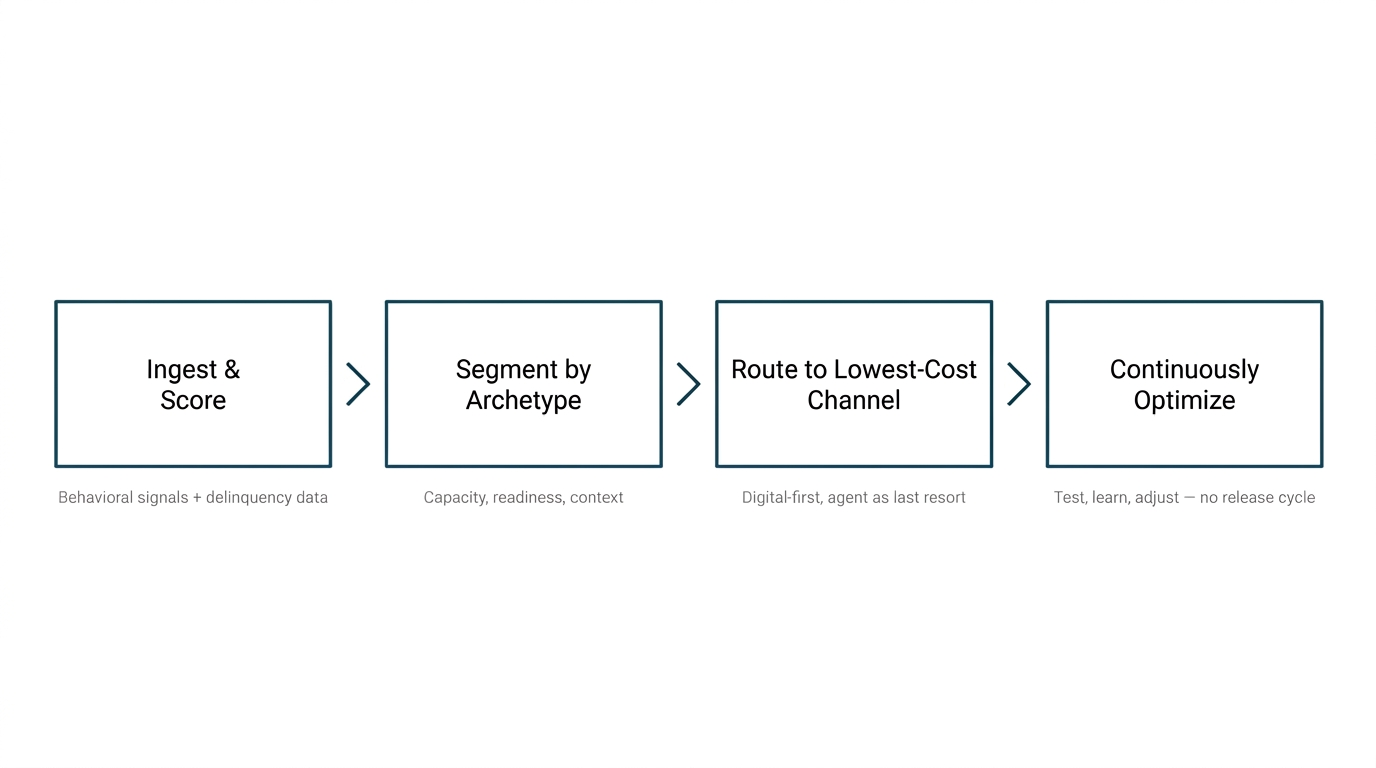
OpEx reduction is a system, not a single tactic — each stage feeds the next.
Lever Three: Extend the Same Discipline to Voice
Call centers remain the most expensive channel in most collections operations, and for many accounts a human conversation is genuinely the right tool. The OpEx question isn't whether to keep voice — it's whether every voice interaction is doing something a cheaper channel couldn't.
SymendConverse applies behavioral science to the outbound voice channel itself — personalizing conversations by archetype and reserving live agent time for the accounts where it adds the most value, rather than running every past-due account through the same call cadence. That's a lower cost-per-contact without abandoning voice for the accounts that need it.
"There are no opinions, no judgments, no emotions."
— Tammy Shanks, Manager of Collections and Customer Service, Rifco, describing the shift to a behavioral science–driven approach.The Compounding Effect
None of these three levers work as a single tactic you flip on. The OpEx reduction compounds because each stage feeds the next — better segmentation improves channel routing, better routing generates more engagement data, and more data sharpens segmentation further. That loop is what separates a one-time cost-cutting exercise from a structural improvement in cost-to-collect.
A leading UK credit card provider cut outbound calls by 83% while collecting £40M, at a 60% cure-rate lift — matching channel to archetype lowered cost-to-collect without sacrificing recovery. One of the largest US utilities applied the same discipline to a 50% reduction in call volume across an $800M delinquent book, generating up to $30M in projected annual value. Across telecommunications, financial services, and utilities portfolios, the pattern holds: OpEx and recovery move together when segmentation, channel, and continuous optimization are integrated rather than managed as separate initiatives.
reduction in outbound calls at a leading UK credit card provider — while collecting £40M at a 60% cure-rate lift.
Where to Start
Start with segmentation, not headcount. Identify which share of your past-due base has the capacity and readiness to self-resolve, and build the routing logic before you touch staffing or outsourcing contracts. The cost savings that follow are durable because they come from matching effort to need — not from doing less for everyone.
Symend has helped enterprises across telecom, financial services, and utilities cure more than 250 million delinquencies and recover over $50 billion, with an average 10x ROI. If you're evaluating where OpEx reduction fits into your 2026 planning, see how SymendCure works end to end or request a custom ROI report to see what these levers could mean for your book.
Cut cost-to-collect without cutting recovery
See how behavioral science–driven segmentation and channel routing lower OpEx while lifting recovery. Book a 15-minute demo or estimate your savings with our cost savings calculator.
TRY THE COST SAVINGS CALCULATOR REQUEST A DEMOKey Takeaways
- OpEx and recovery are not a trade-off: Enterprises using behavioral science–driven engagement have cut collections OpEx by an average of 50% while simultaneously improving recovery by up to 10% — the key is spending precisely on the right customers, through the right channel, at the right moment.
- Segmentation is where the savings originate: Classifying accounts by capacity to pay and readiness to act — not just risk score — drives an average 85% reduction in agent interactions without a corresponding drop in recovery.
- Digital self-service requires behavioral targeting to hold: Routing the right customers to self-service is what separates sustainable OpEx reduction from cure rate deterioration. One Symend client cut outbound calls by 80% while 27% of customers self-cured using digital channels alone.
- Voice is the last lever, not the first cut: SymendConverse applies behavioral science to the outbound voice channel, reserving live agent time for accounts where human conversation adds the most value — lower cost-per-contact without abandoning voice for the accounts that need it.
- The gains compound: Better segmentation improves channel routing, better routing generates engagement data, and more data sharpens segmentation — a structural reduction in cost-to-collect, not a one-time exercise.
Frequently Asked Questions
Enterprises using Symend's approach have seen an average 50% reduction in total OpEx and an 85% reduction in agent interactions, alongside up to 10% higher recovery rates — driven by routing customers to the channel most likely to convert rather than applying uniform outreach.
No — the opposite tends to be true. The savings above come from matching tone, channel, and timing to each customer's actual situation, which improves the customer experience rather than degrading it.
AI-only tools optimize contact frequency and timing based on historical patterns. Behavioral science adds the psychological layer — understanding why a customer hasn't paid and what will move them to act — which is what determines whether outreach converts instead of just arriving on schedule.
Start with segmentation: identify which portion of the past-due base has the capacity and readiness to self-resolve, and route them to self-service before adding headcount or new channels.
Voice doesn't need to disappear — it needs to be reserved for the accounts that genuinely benefit from it. Applying behavioral targeting to voice interactions themselves lowers cost-per-contact while keeping live conversations available where they matter most.