Why Your Collections Platform Takes a Quarter to Change a Send Window
The hidden tax on enterprise collections isn't licensing. It's release cycles, change orders, and the strategy ideas that die waiting for them.

Key Takeaways
- A one-afternoon strategy idea — like moving a send window two hours later for a segment — routinely takes enterprise collections teams a full quarter to ship.
- The delay is rarely engineering. It's change orders, cross-system integration coordination, release-cycle alignment, multi-system QA, and compliance queues stacked in series.
- The change-order economy is a vendor business model decision, not a technology limitation. Modern platforms can support configuration changes without a release cycle.
- Configuration-led collections lets business users create segments, launch hardship programs, and adjust send windows in seconds — no ticket, no release cycle, no change order.
- Iteration speed compounds: ten changes per quarter for a year produces a different recovery curve than two. The platform's iteration speed is the curve.
It's Tuesday morning. Your collections analyst spots a clear pattern in the data: customers in two specific regions are showing higher hardship signals, and the standard send window — built around national averages — is firing messages at the worst possible time for that cohort. The fix is obvious. Move the send window two hours later for those segments. Run it for 30 days. See if cure rates improve.
It's a one-afternoon idea. By the time it actually ships, your analyst has presented on it in two QBRs.
Every enterprise collections team has a version of this story. The strategy is sound, the data is there, and the platform — in theory — is capable of the change. What gets in the way isn't the idea. It's the operational machinery sitting between the idea and the production system: change orders, release cycles, vendor coordination, integration tickets, QA windows across half a dozen stitched-together tools. By the time the change is live, the conditions that prompted it have already shifted.
This is the silent tax on enterprise collections. And once you start counting what it costs, the size of the bill is hard to look away from.
Where the quarter actually goes
Most leaders assume the delay is mostly engineering. It almost never is. Engineering work on a configuration change like a send-window adjustment is genuinely small — often a few hours of build, a day or two of QA. The other 87 days come from somewhere else.
Walk a typical change through a legacy collections stack and you'll find time bleeding out at five distinct points:
- Scoping and change-order approval with the vendor, because the change touches a system covered by a managed-services contract.
- Integration coordination across the systems that have to acknowledge the change — the data layer, the decisioning engine, the orchestration layer, the comms platform, the analytics warehouse.
- Sprint planning and release-cycle alignment, because the vendor ships changes on a 4- or 6-week cadence regardless of how small the change is.
- Multi-system QA, because a tweak in one tool has to be re-validated against the data flowing through the others.
- Compliance and infosec review, which is legitimate work but tends to sit in a queue for weeks.
Any one of these is bearable. Stacking all of them in series, on every meaningful strategy change, is what produces the quarter-long lag. And the cumulative effect is worse than the sum of the parts: teams stop proposing changes because they know what shipping one costs. Operational caution masquerades as strategic discipline. The platform's stated capabilities and its lived ones drift further apart with every cycle.
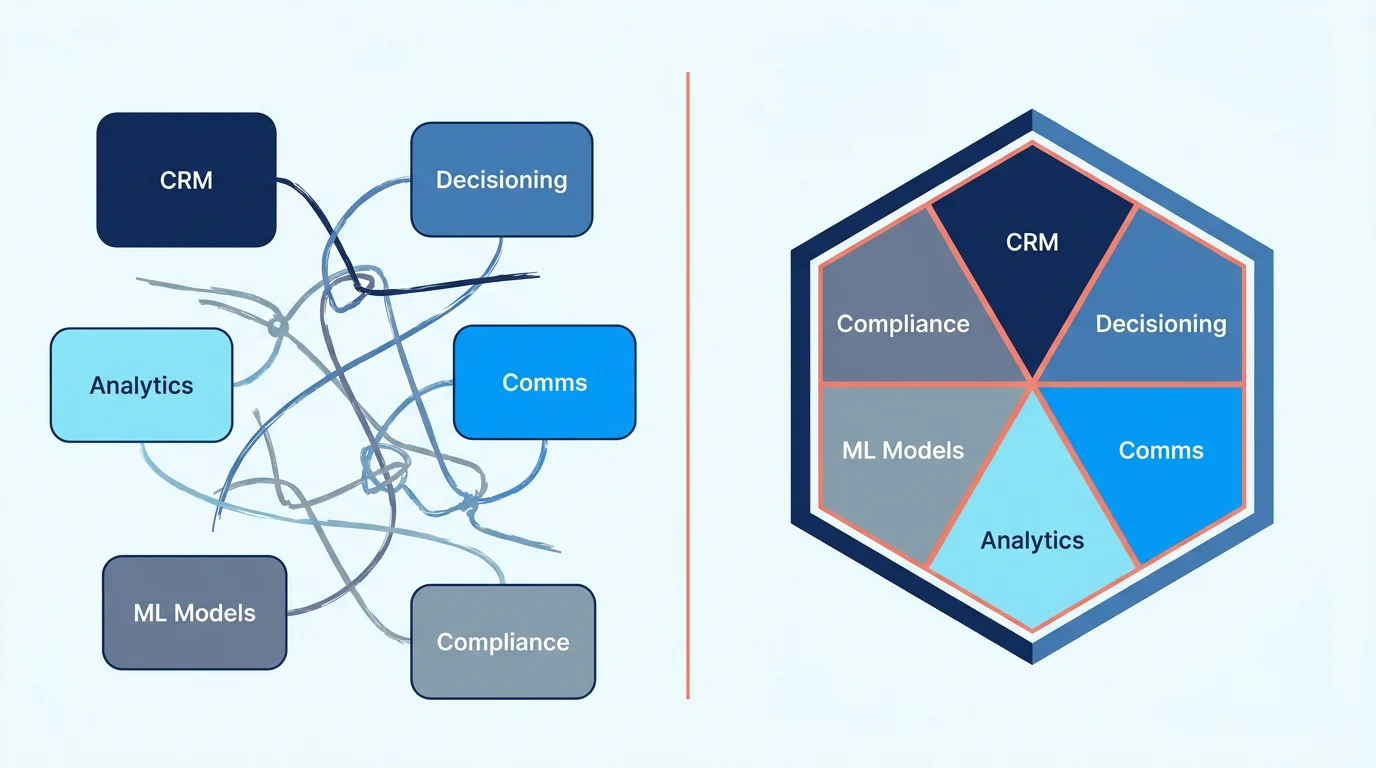
A stitched-together stack forces every change through cross-system coordination. A unified platform absorbs the same change as configuration.
"By the time the change ships, the conditions that prompted it have already shifted. Welcome to collections at legacy speed."
The change-order economy is a vendor decision, not a technology one
The frustrating part is that the underlying technology can do better. Modern collections platforms are perfectly capable of supporting configuration changes — segment rules, business rules, send windows, parent-child account relationships, channel cadences — without a release cycle. The reason most legacy vendors don't operate that way is commercial, not technical. Change orders are revenue. Managed-services scope is revenue. Release cycles that bundle dozens of small client requests into a single deployment train protect engineering capacity and create predictable upsell.
It's a defensible business model. It is not, however, the business model your collections team needs in a year where consumer behavior is shifting every quarter, hardship signals are spiking unevenly across regions, and the difference between catching a delinquency trend in week one versus week thirteen is the difference between a successful intervention and a write-off.
The economic logic that produced the change-order economy was built for a slower world. In the era of monthly billing cycles, annual strategic planning, and quarterly business reviews, a 12-week turnaround on a strategy adjustment looked acceptable. In 2026, with consumers receiving hundreds of messages a day and macro conditions reshuffling delinquency portfolios every few months, it's a structural disadvantage.
What configuration-led collections actually looks like
There's a different operating model emerging, and the language to describe it is increasingly clear: configuration, not customization. Business users, not engineers. Seconds, not days.
The defining test is simple. In a configuration-led platform, the following changes happen inside the product, by the operations or strategy team, without a vendor ticket:
- Creating or modifying a customer segment
- Launching or pausing a hardship program
- Adjusting send windows by region, day of week, or behavioral signal
- Pulling a customer out of a journey when a threshold is hit
- Adding a new channel cadence or modifying an existing one
- Changing parent-child account treatment rules
None of these require code. None require a release cycle. None require a change order — because none of them are customizations. They're the things the platform was built to let business users do.
The downstream effect on operations is significant. When the cost of testing a strategy idea drops from a quarter to an afternoon, teams test more. When they test more, they learn faster. When they learn faster, the system gets smarter. The compounding effect is the part most legacy buyers underestimate: it's not that any single change matters enormously; it's that ten changes per quarter, compounding for a year, produces a different recovery curve than two changes per quarter over the same year. This is exactly why experimentation is essential to continuously improving customer engagement.
"Ten changes per quarter, compounding for a year, produces a different recovery curve than two changes per quarter. The platform's iteration speed is the curve."
The proof shows up in the case studies
The most consistent pattern in Symend's deployments is what happens when teams stop being constrained by their platform's iteration speed. A few examples worth flagging:
Rifco, Canada's leading non-prime auto lender, reached a 26.6% self-cure rate and an 80% reduction in outbound call volume using behavioral science–driven engagement and Delinquency Archetypes. Getting there meant iterating on segmentation and outreach strategy until they found what worked for that portfolio — the kind of continuous tuning that only happens when strategy changes don't wait on a release cycle.
self-cure rate at Rifco, with an 80% reduction in outbound call volume, using behavioral science–driven engagement.
TELUS achieved an 85% reduction in inbound agent interactions and a 220% increase in digital engagement during the volatility of COVID — a period when send windows, hardship messaging, and channel strategy needed to shift on a week-by-week basis. A platform locked to a fixed release cycle would have been a quarter behind the conditions on the ground the entire time.
A leading UK credit card provider delivered a 60% cure-rate lift and an 83% reduction in outbound calls while collecting £40M — outcomes built on archetype-driven, behavioral science–led engagement, refined as customer response patterns evolved.
The common thread isn't the headline metric — it's the behavioral science and Delinquency Archetypes behind each program. But none of those results are reachable on a stack where every strategy change takes a quarter of cross-system coordination. The operating model is what lets the science actually run at the speed the portfolio demands.
Four questions to ask any collections vendor
If you're evaluating a platform — incumbent or new — the configuration question is the one that surfaces the truth fastest. Four questions to put on the table:
- Walk me through a recent client change request that took less than 48 hours. What was it, and who made it — the vendor or the client?
- What percentage of strategy changes at your top accounts require a change order or a scoped engagement?
- Can a business user — not an engineer — create a new segment, launch a new hardship program, and modify a send window without filing a ticket?
- What does your release cycle look like for client-requested changes, and what's the smallest change that has to wait for it?
Honest answers to these questions tell you more than any feature-comparison matrix. A vendor whose business model depends on change orders will struggle to answer them cleanly. A platform built for configuration will answer them in specifics.
The bottom line
The competitive edge in collections in 2026 isn't a single feature, a single AI model, or a single behavioral framework. It's iteration speed — the operational ability to act on what your data is telling you before the moment passes. Every release cycle and every change order is a tax on that ability. Eventually, it's a tax that shows up in your recovery curve, your OpEx ratio, and the difference between the team that's catching delinquency trends in week one and the team that's catching them in week thirteen.
If you want to see what configuration-led collections looks like in practice, the SymendCure platform is built around the idea that business teams should be able to change segments, programs, and send windows in seconds, not quarters. For an end-to-end view of how this approach is deployed, see how the Symend platform works, or explore industry-specific applications across banking, telco, utilities, and auto finance.
See what configuration-led collections looks like
Change segments, programs, and send windows in seconds — not quarters. Book a 15-minute demo to see how business teams iterate on strategy without a release cycle.
EXPLORE SYMENDCURE REQUEST A DEMOKey Takeaways
- Engineering time is almost never the bottleneck: A send-window change involves a few hours of build and a day or two of QA. The other 87 days come from change-order approval, integration coordination, release-cycle alignment, multi-system QA, and compliance queues — none of which are engineering problems.
- The change-order economy is a vendor business-model choice, not a technical constraint: Legacy platforms monetize complexity. A configuration-led platform makes the same adjustment in seconds because it was designed to be operated by business users, not managed by engineers.
- Configuration vs. customization is the design distinction that determines velocity: Configuration means business users adjust segments, messaging, and timing without code changes or vendor involvement. Customization means every change requires engineering, a change order, and a release cycle.
- Iteration speed is a direct competitive advantage: The ability to run more experiments per quarter than competitors translates directly into faster convergence on higher-performing strategies. One Symend client achieved a 26.6% self-cure rate with an 80% reduction in outbound calls by iterating on behavioral strategy — not by waiting for a release window.
- The silent tax compounds every quarter: Every quarter spent waiting for a strategy change is a quarter without the engagement data that change would have generated — and that data is what the model trains on next. The velocity gap widens over time, not just in the current cycle.
Frequently Asked Questions
Configuration means changes a business user can make inside the product, through interface controls — creating segments, adjusting send windows, launching a hardship program, modifying channel cadences. Customization means changes that require engineering work, vendor involvement, or a release cycle. The ratio of configuration-to-customization in a given platform is one of the strongest predictors of how fast your team will be able to iterate on strategy.
For a configuration-level change — a new segment, a send-window adjustment, a hardship program launch — the answer should be hours, not weeks. For changes that genuinely touch the underlying data model or integrations, days to weeks is reasonable. If your vendor is quoting quarters for routine strategy adjustments, the platform's commercial model is the bottleneck, not the technology.
Change-order economics were built for an earlier generation of enterprise software, when implementations were heavyweight, deployments were on-premise, and the vendor's professional services team was both a margin center and a quality-control mechanism. The model is defensible for genuinely customized work but mismatched to a world where the platform's job is to support continuous, business-user-led iteration on strategy.
Symend client deployments typically move from kickoff to live pilot in weeks rather than months, with a defined 90-day pilot timeline that produces measurable performance benchmarks before scale-up. White-glove implementation handles the data, brand templates, campaign configuration, and testing, so the client team's operational lift stays low.
Across documented Symend deployments, clients have seen recovery-rate improvements of roughly 10%, OpEx reductions of about 50%, and 10x ROI. Specific case studies have shown 60% cure-rate lifts, 80%+ reductions in outbound call volume, and tens of millions in annual value. The variation depends on portfolio composition and starting baseline, but the directional pattern is consistent: when teams can iterate freely, outcomes improve materially within the first year.