
How Enterprises Are Using Behavioral Science to Transform Collections
Every collections vendor now claims to use AI. The enterprises pulling ahead pair it with behavioral science — and let psychology, not prediction alone, decide what to say.

Key Takeaways
- AI in collections is now table stakes — prediction without psychology just automates the wrong guess, faster.
- Behavioral models classify past-due customers into four Delinquency Archetypes on two axes: capacity to pay and readiness to act.
- AI supplies scale, prediction, and continuous optimization; behavioral science determines what to actually say — tone, timing, channel, and content.
- The results come from relevance, not volume: sending the right message to the right archetype at the right moment.
- Across Symend deployments: 250M+ delinquencies cured, $50B+ recovered, an average 10x ROI, up to 10% higher recovery, and roughly 50% lower OpEx.
Every collections vendor now claims to use AI. That claim used to be a differentiator; today it's table stakes, and for enterprise collections leaders it's become part of the problem. Bolting a generic virtual agent or a risk-scoring model onto a legacy collections process can automate outreach, but it can't explain why a specific customer stopped paying, what's stopping them from re-engaging, or which message will actually move them to act. Prediction without psychology just automates the wrong guess, faster.
That's why a growing number of enterprise telecom, financial services, utility, and auto finance organizations are shifting to a different model: pairing AI with behavioral science. This post breaks down what that actually looks like in practice — how enterprises segment, personalize, and optimize collections engagement around customer psychology, and what results they're seeing.
How are enterprises using behavioral science for collections? Enterprises classify past-due customers into behavioral archetypes based on their capacity to pay and readiness to act, then tailor the tone, timing, channel, and content of every outreach to match. AI powers the scale and prediction; behavioral science determines what to actually say — and that combination, not AI alone, is what drives higher recovery rates and lower cost to serve.
Why AI Alone Has Stopped Moving the Needle
Enterprise collections teams have spent the last several years automating outreach — more emails, more texts, more outbound calls, more channels running in parallel. The problem is that customers feel it. People are already saturated with digital messages, and a past-due customer bombarded by five automated reminders that all say the same thing in the same tone isn't more likely to pay; they're more likely to disengage entirely.
At the same time, the macro backdrop keeps raising the stakes. Total U.S. household debt stood at $18.8 trillion in Q2 2026, with 4.7% of outstanding balances in some stage of delinquency, according to the Federal Reserve Bank of New York — and auto loan and credit card delinquencies remain elevated even as the aggregate rate has leveled off. Collections teams aren't just managing volume; they're managing a customer base under real financial strain, where indebtedness itself is tied to shame and avoidance, and generic pressure tactics tend to backfire.
Legacy platforms and many newer AI-only vendors share the same blind spot: they treat collections as a prediction problem — will this customer pay, yes or no — rather than a behavioral one. Risk scores tell you who is likely to default. They don't tell you why, and they don't tell you what kind of message will change the outcome.
"Prediction without psychology just automates the wrong guess, faster."
What "Behavioral Science" Actually Means in Enterprise Collections
Delinquency Archetypes replace one-size-fits-all risk segmentation
Instead of segmenting purely by credit risk or days-past-due, behavioral models classify customers along two dimensions: financial capacity to pay and psychological readiness to act — producing four archetypes, each with a different optimal treatment. A high-capacity, low-readiness customer isn't struggling — they're distracted or avoiding an unpleasant task, so a frictionless "pay in one click" message outperforms an empathetic one. A low-capacity, high-readiness customer wants to pay but can't right now, so a flexible payment plan and supportive tone wins. Treating both the same wastes the outreach on both.
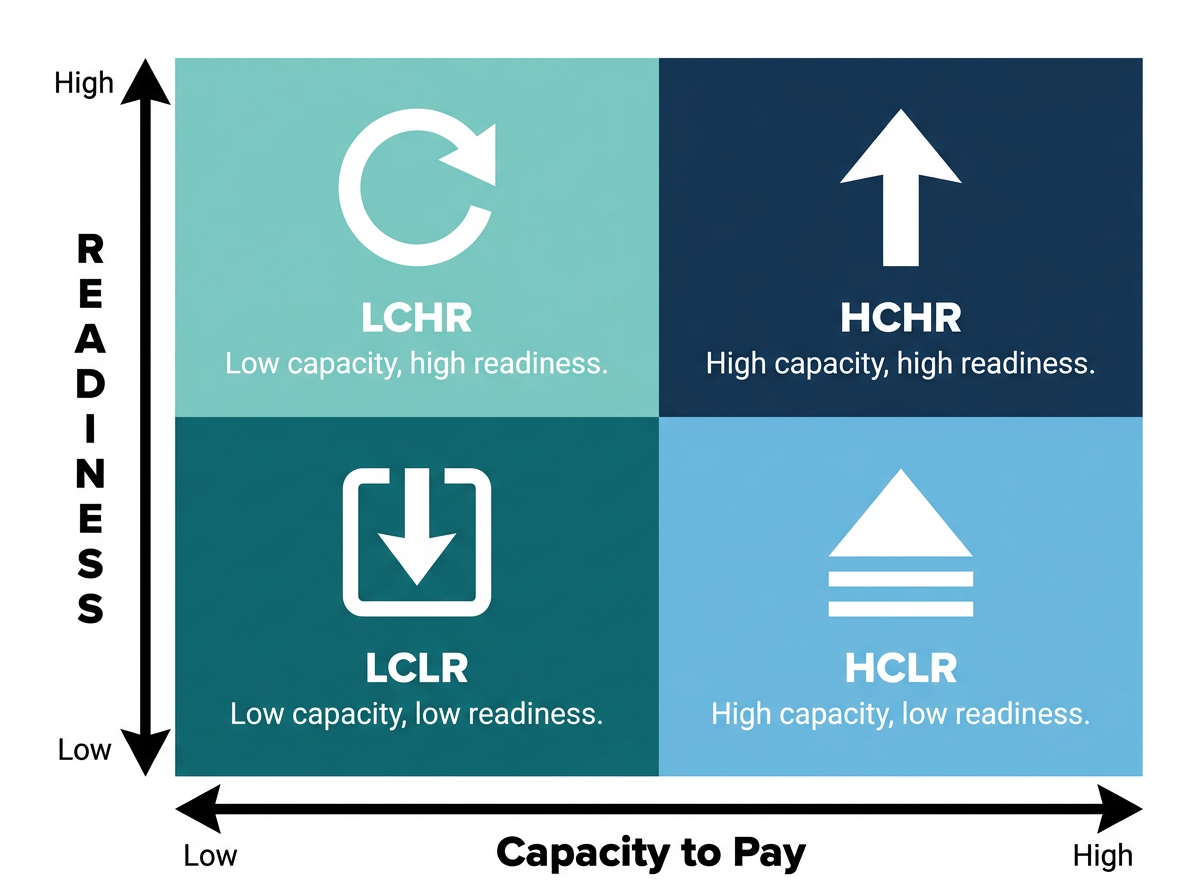
Two axes — capacity to pay and readiness to act — produce four archetypes, each with a different optimal treatment.
Psychological triggers are applied deliberately, not intuitively
Once an archetype is identified, enterprises apply specific tactics — loss aversion, simplicity bias, social proof, goal-setting — to individual messages, testing which tactic resonates for which archetype and context. Our breakdown of seven behavioral science tactics that determine whether a customer pays covers the specific levers.
AI supplies the scale, speed, and continuous optimization
Predictive models score and segment customers using on- and off-platform data. Reinforcement learning continuously adjusts outreach based on real-time response, moving beyond static A/B testing. Natural language processing reads sentiment and intent to keep archetype assignments current. Generative AI produces message variants at enterprise scale. None of this is optional — but none of it decides what to say. That's the behavioral layer, and it's what purely AI-driven platforms are missing.
How Enterprises Put This to Work, Step by Step
- Score and segment. Incoming data from billing, engagement history, and external signals assigns a behavioral archetype at first contact.
- Generate personalized engagement journeys. Each archetype maps to a distinct tone, channel mix, cadence, and tactic set across email, SMS, push, self-service, and voice.
- Re-score and re-segment in real time. New signals reclassify the customer as their situation changes, so the journey adapts instead of running on autopilot.
- Optimize down to the message level. Enterprises test specific attributes — subject lines, CTAs, send times — within each archetype, converging on what works over time.
Real Results: What This Looks Like at Enterprise Scale
Across its enterprise client base, Symend has cured more than 250 million delinquencies and recovered over $50 billion in payments, with clients seeing an average 10x ROI, up to 10% higher recovery rates, and roughly 50% reductions in total OpEx.
In telecommunications, TELUS increased digital interactions with past-due customers by 220% in under four months, easing pressure on call center teams during a period of rising call volumes. Across telecom deployments more broadly, enterprises have seen an average 85% reduction in agent interactions alongside that roughly 50% OpEx reduction.
In financial services, a major North American bank consolidated collections across more than a dozen product lines and saved over $25 million — at an 11x ROI, with a 6% early-stage cure-rate lift and a 23% reduction in early-stage roll rates. Proactively identifying "willing but stretched" customers early is what turns a behavioral read into recovered revenue and lower bad-debt provisions at scale.
increase in digital interactions with past-due customers at TELUS, in under four months — shifting volume away from the call center as call volumes rose.
The consistent thread: the lift doesn't come from sending more messages. It comes from sending the right message, to the right archetype, at the right moment.
"The lift doesn't come from sending more messages. It comes from sending the right message, to the right archetype, at the right moment."
Getting Started: What Enterprises Need to Activate This
- Clean, unified data. Fragmented sources across billing, payment history, and engagement channels slow activation more than anything else.
- Executive alignment on measurement. Cure rate, time-to-cure, roll rate, and OpEx — not just call volume.
- A platform built for continuous testing, not static campaigns that require manual rebuilds for every new test.
- Compliance built in from the start. CFPB, state privacy, and (in Canada) provincial privacy requirements as a design constraint, not an afterthought.
The Bottom Line
AI-only collections tools can automate outreach at scale, but scale isn't the bottleneck anymore — relevance is. SymendCure combines behavioral archetypes with AI-driven engagement across the collections lifecycle, and SymendConverse extends the same behavioral model to voice, so every channel is working from the same psychological read on the customer.
If you're evaluating what this could mean for your recovery rates and cost to collect, see how the Symend platform works or estimate the impact for your own portfolio.
See what behavioral science could do for your recovery rates
Pair AI with behavioral science across the collections lifecycle. Estimate the impact on your cost to collect, or book a 15-minute demo.
TRY THE COST SAVINGS CALCULATOR REQUEST A DEMOKey Takeaways
- AI in collections is table stakes; psychology is the differentiator: Prediction tells you who is likely to default, not why they stopped paying or what message will move them. Prediction without psychology just automates the wrong guess, faster.
- Proven across Symend deployments: More than 250 million delinquencies cured and over $50 billion recovered, with clients seeing an average 10x ROI, up to 10% higher recovery rates, and roughly 50% lower total OpEx.
- The lift comes from relevance, not volume. Enterprises score and segment past-due customers into behavioral archetypes, then match tone, timing, channel and content to each one — re-scoring in real time as the customer's situation changes.
- Behavioral science defines the variables, data science defines the methodology, and the platform executes. Proprietary Delinquency Archetypes decode each customer's capacity to pay and readiness to act, delivering empathetic, personalized outreach that resolves accounts and preserves the relationship.
Frequently Asked Questions
Enterprises classify past-due customers into behavioral archetypes based on capacity to pay and readiness to act, then use AI to personalize the tone, timing, channel, and content of outreach for each archetype — continuously refining the approach as customers respond.
A behavioral classification — high or low capacity to pay crossed with high or low readiness to act — that predicts why a customer isn't paying and what engagement is most likely to change that, rather than relying on credit risk alone.
AI-only tools are strong at prediction and automation but don't determine what a message should say or how it should feel. Behavioral science supplies that layer — tested psychological principles determining content and framing — with AI handling scale and real-time optimization.
Across Symend deployments: an average 10x ROI, up to 10% higher recovery rates, and roughly 50% OpEx reduction — with 250M+ delinquencies cured and $50B+ recovered. Named examples include TELUS's 220% increase in digital interactions and an average 85% reduction in agent interactions across telecom deployments.
Telecommunications, financial services (banks, lenders, credit unions), utilities, and auto finance — with tactics and compliance requirements adapted to each vertical.