
Three Questions to Ask Any Collections Vendor in 2026
Feature lists won't tell you which collections platform actually performs. These three questions will.

Key Takeaways
- RFP responses and feature-comparison matrices have converged — they no longer separate platforms that produce outcomes from ones that produce demos.
- Three questions map to what actually moves a recovery curve: behavioral foundation, iteration speed, and architectural integration.
- Behavioral foundation: ask how the platform segments beyond a risk score, and where the behavioral science team sits in the company.
- Iteration speed: ask how long a real strategy change takes, and whether a business user can make it without filing a ticket.
- Architecture: ask where data, models, journeys, and analytics actually live — one architecture diagram, or five.
If you've sat through a collections vendor pitch in the last year, you've probably heard the same vocabulary on repeat. Behavioral. AI-powered. End-to-end. Real-time. Personalized. Every deck has the language; not every platform has the substance behind it. RFP responses have converged on a common script, and feature-comparison matrices have stopped doing useful work separating the platforms that produce outcomes from the ones that produce demos.
Three questions tend to surface the truth faster than a 200-row RFP. They map to the three things that actually determine whether a collections platform will move your recovery curve: the foundation it's built on, the architecture beneath it, and the speed at which your team can act on what it learns. Honest answers to these questions tell you more than any feature list.
1. Is behavioral science your foundation, or a feature you bolted on?
Most modern collections vendors now claim behavioral capabilities. The word has been stretched until it covers everything from genuine psychological intervention design to slightly more granular risk scoring with a new label on it. The distinction matters because it determines whether the platform is actually trying to change customer behavior or just measure it more accurately.
How to surface the answer: ask how the platform segments customers beyond a risk score. If the response is "more granular risk tiers" or "propensity-to-pay modeling," it's behavioral analytics with a rebrand. If the response involves distinct psychological profiles built on capacity to pay and readiness to act — with different intervention strategies tied to each — it's closer to behavioral science. Ask where the behavioral science team sits in the company. If behavioral expertise lives in marketing copy rather than in product, data science, and content design, the foundation isn't really there.
For a deeper read on the distinction, here's why behavioral science isn't an ingredient — it's the architecture.
"If a vendor's behavioral story falls apart the moment you ask how their segmentation actually works, the rest of the pitch probably won't hold up either."
2. How long does a real strategy change actually take?
This is the question most vendors hate, because the honest answer is uncomfortable. Most legacy platforms ship changes on a 4- to 6-week release cycle, regardless of how small the change is. A new segment, a hardship program adjustment, a regional send-window tweak — every one of them gets scoped as a change order, queued for a sprint, integrated across multiple systems, QA'd, and shipped on the vendor's calendar. By the time the change is live, the conditions that prompted it have usually moved on.
How to surface the answer: ask the vendor to walk you through a recent client change request that took less than 48 hours. Ask who made it — vendor engineers or the client's own operations team. Ask what percentage of strategy changes at their top accounts require a change order. Ask whether a business user can create a new segment, launch a new hardship program, and modify a send window without filing a ticket. Vendors whose commercial model depends on change orders will struggle to answer these cleanly. Platforms built for configuration will answer them in specifics.
The cost of slow iteration compounds. Rifco reached a 26.6% self-cure rate and an 80% reduction in outbound call volume with behavioral science–driven engagement — the kind of program a team can only tune into shape by iterating faster than a release cycle allows. On a stack where every strategy change takes a quarter, those outcomes stay out of reach.
self-cure rate at Rifco, with an 80% reduction in outbound call volume — from behavioral science–driven engagement, iterated at configuration speed.
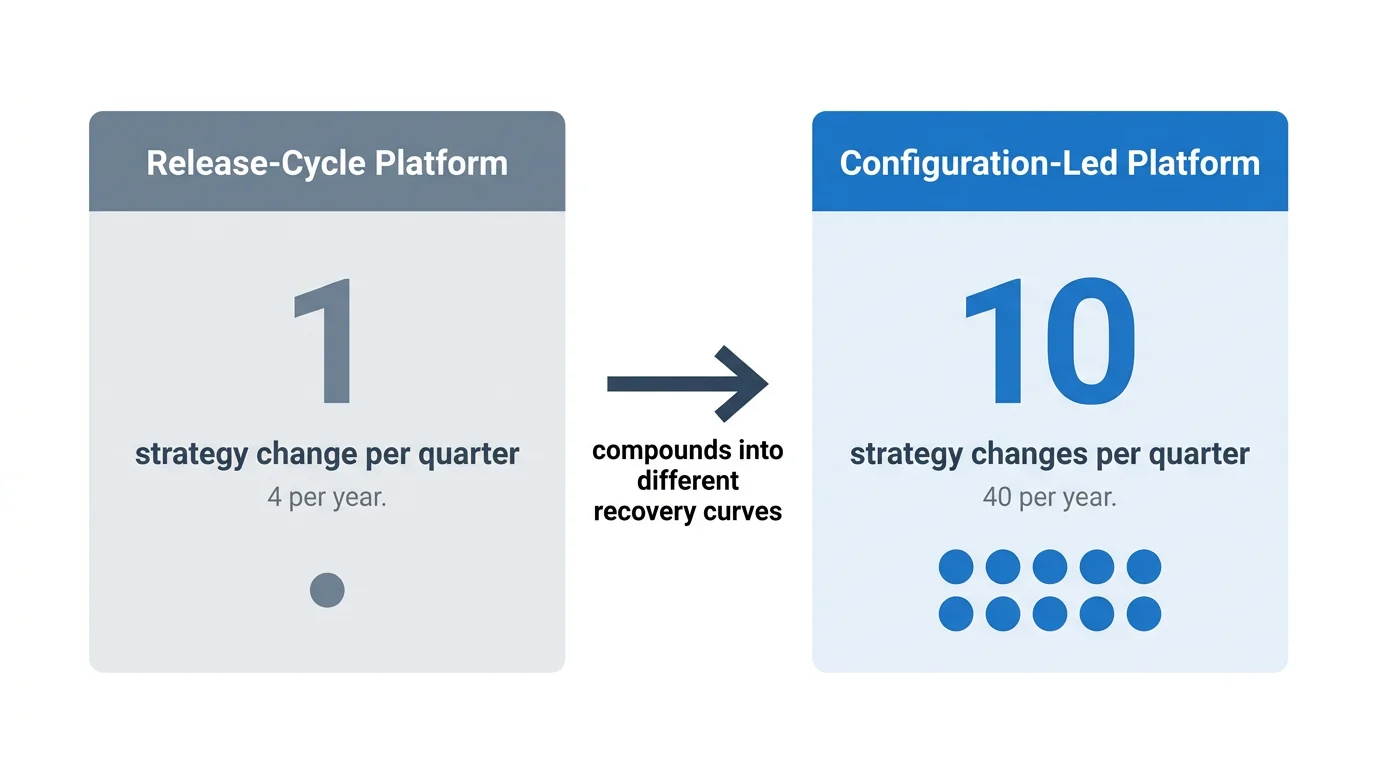
One strategy change a quarter versus ten. Over a year, the gap compounds into materially different recovery curves.
3. Where do your data, models, journeys, and analytics actually live?
This question separates platforms that are genuinely end-to-end from platforms that are end-to-end on the pitch slide and stitched-together in practice. The architecture matters because every seam between systems — every place where data has to be moved, transformed, or coordinated across vendors — is a place where iteration slows down, signals get lost, and your ML models train on a partial view of the customer.
How to surface the answer: ask where the scoring model lives relative to the journey orchestrator. Ask whether engagement signals captured by the comms platform feed the scoring model in real-time, or only on a weekly batch. Ask how many separate vendor systems are involved in a single customer journey. Ask what compliance logic looks like across channels — is consent management implemented once and propagated, or implemented separately in each tool? A genuinely unified platform will answer with a single architecture diagram. A duct-taped one will answer with five.
The proof is in what becomes possible at scale. A major North American bank consolidated collections across more than a dozen product lines onto a unified platform and saved over $25M, with an 11x ROI and a 23% reduction in early-stage roll rates — outcomes that depend on having a single source of truth across products, channels, and analytics.
saved by a major North American bank — at 11x ROI, with a 23% reduction in early-stage roll rates — after consolidating a dozen-plus product lines onto one platform.
The bottom line
Every collections vendor will tell you they have behavioral capabilities, that they support rapid iteration, and that their platform is end-to-end. All three claims are easy to make in a pitch deck. None of them are easy to fake when a buyer asks the right follow-up questions. The honest answers on behavioral foundation, iteration speed, and architectural integration will tell you everything the RFP can't.
If you want to see what "yes" looks like on all three questions, SymendCure is built around these as design principles, not features. For deployment patterns and proof points by industry, the financial services, telecommunications, utilities, and auto financing pages walk through the specifics. The full case study library is where the answers stop being pitches and start being numbers.
Put these three questions to us
Behavioral foundation, iteration speed, architectural integration — SymendCure was built to answer all three in specifics. Book a 15-minute demo and ask.
EXPLORE SYMENDCURE REQUEST A DEMOKey Takeaways
- Feature comparison matrices are the wrong evaluation tool: Every vendor's demo looks compelling. The three questions that actually separate platforms are about behavioral foundation, iteration speed, and architectural integration — not feature checklists.
- Ask whether behavioral science is the foundation or a feature: "Behavioral" is now claimed universally. The real question is whether the platform segments customers on capacity to pay and readiness to act, or whether behavioral language has been layered onto an analytics-only architecture.
- Iteration speed reveals what the architecture actually is: How long a real strategy change takes — not how the vendor describes it — is the clearest proxy for whether the platform is configuration-led or change-order-dependent. Legacy platforms average a quarter for adjustments that should take minutes.
- Where data, models, and journeys live determines the ROI trajectory: A platform running the full loop internally — score, segment, engage, learn — compounds improvement over time. A fragmented stack coordinates across vendors, training multiple models on partial datasets instead of one on the full picture.
- The right architecture changes the outcome numbers: One Symend client achieved a 26.6% self-cure rate with an 80% reduction in outbound calls. A leading bank generated $25M+ in annual value at 11x ROI with a 23% roll-rate reduction.
Frequently Asked Questions
Iteration speed. Most RFPs spend significant attention on features, integrations, and pricing, and almost no attention on how long it takes the vendor's average client to actually change a strategy in production. That cycle time — from "we noticed a pattern in the data" to "we have a new strategy live" — is the single strongest predictor of whether a platform will keep producing results in year two and year three, or plateau after the initial deployment bump.
Three quick tests: ask where the behavioral science team sits in the company, ask for the segmentation framework in detail (not the pitch slide), and ask for documented client outcomes that depend on the behavioral approach rather than on more frequent contact. Real behavioral science platforms will be able to walk through psychological mechanisms, archetype definitions, and intervention design. Rebranded analytics platforms will pivot back to scoring and propensity models within two questions.
Across documented Symend deployments, clients have seen 10x ROI, roughly 10% improvements in recovery rates, and approximately 50% reductions in OpEx, with individual case studies showing larger results — $25M+ in combined savings at a major bank, up to $30M in annual value at a US utility, and 60% cure-rate lifts at a UK credit card provider. Any serious vendor in this space should be able to point to documented, validated outcomes at comparable scale. If the answer is mostly forward-looking projections, that's a signal.
Weeks to live pilot, not months. The 90-day pilot is becoming the standard benchmark for modern collections platforms — long enough to produce reliable performance comparisons against existing processes, short enough to make the buying decision genuinely evidence-based. If a vendor is quoting 6–12 month implementations before any measurable outcomes, the platform's architecture is probably the bottleneck.
Yes, and the pilot should be structured to produce statistically meaningful comparisons — ideally with a control group or holdout population, comparable account characteristics across the test and control, and pre-defined success metrics. The strongest collections deployments in the market — including the major bank case study referenced above — have validated impact through internal A/B tests with holdouts of around 10% of the relevant population. That's the level of rigor a serious vendor should welcome, not avoid.