What Enterprises Get Wrong About “Personalization” in Collections
Most “personalized” collections messages just insert a first name into a generic template. Real personalization means matching the message to why a customer hasn't paid.
Key Takeaways
- Inserting a name, balance, or due date into a template is token personalization. It changes how a message looks, not what it says.
- Real personalization in collections matches the tone, timing, channel, and behavioral approach of a message to why a specific customer hasn't paid.
- Genuine personalization works on four levers: content, tone, timing and cadence, and channel. Token personalization touches none of them.
- General-purpose generative AI can make messages read warmer without making them fit the customer's situation any better.
- Personalization has to be dynamic: re-evaluated as engagement, payment attempts, and responses provide new signal across a delinquency episode.
“Hi [First Name], your account is overdue.” Swap in the customer's name, maybe their balance, maybe a due date — and most collections platforms call that personalized. It isn't. It's a mail merge wearing personalization's clothes, and enterprises that stop there are leaving most of the value on the table.
This matters more than it sounds like it should, because “personalization” has become one of those words every vendor claims and almost nobody defines the same way. For a telecom, a bank, a utility, or an auto lender evaluating collections technology, the gap between “inserts a token” and “adapts to why this customer hasn't paid” is the difference between a 2-point lift and a genuinely different recovery curve.
What does personalization really mean in debt collection?Real personalization in debt collection means matching the tone, timing, channel, and behavioral approach of a message to why a specific customer hasn't paid — not just inserting their name or balance into a static template. Token-based personalization changes what a message looks like. Behavioral personalization changes what it says and how it says it, based on the customer's actual financial capacity and psychological readiness to act.
The Personalization Enterprises Already Have
Most enterprise collections stacks already do token-based personalization well: first name, account balance, due date, maybe a dynamically inserted late fee amount. It's table stakes, and it's been table stakes for over a decade. The data fields most platforms treat as “content personalization” — first name, last name, balance, tenure — read more like a mail-merge field list than a behavioral strategy, because that's exactly what they are.
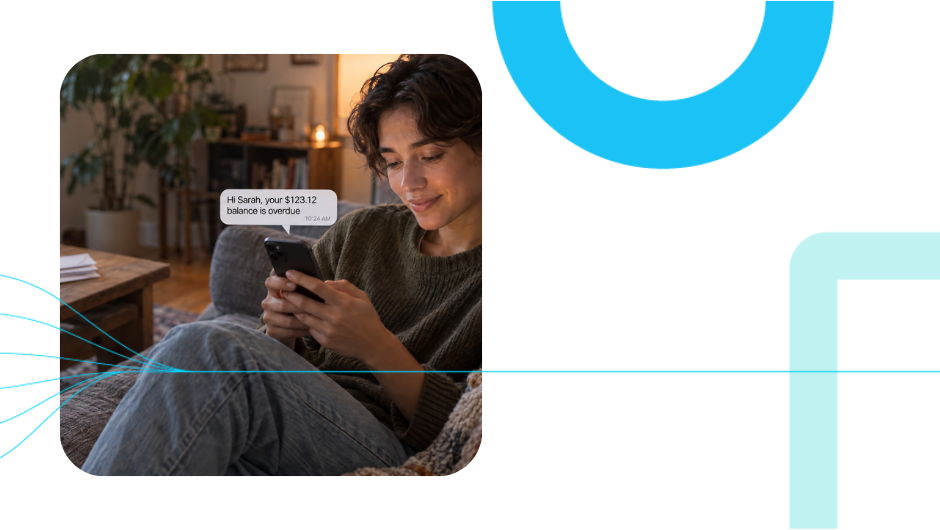
The problem isn't that token insertion is bad. It's that it gets mistaken for the whole job. A message that says “Hi Sarah, your $123.12 balance is overdue” is more personal-looking than a fully generic one, but it doesn't actually change the customer's likelihood of responding, because it doesn't address why they haven't paid yet. Two customers named Sarah, with identical balances, can be in completely different situations — one distracted and financially fine, one under real financial stress — and the token-personalized message treats them identically anyway.
Where Real Personalization Actually Lives
Genuine personalization operates on four levers, and enterprises that only touch the first one are personalizing the least important part of the message:
- Content — what the message actually says, beyond the customer's name. Does it lead with a fee the customer stands to lose (loss aversion), a simple next step (ease framing), or an acknowledgment of hardship (empathy)? The behavioral tactic embedded in the copy matters more than any token.
- Tone — how the message sounds. A customer who's engaged and capable of paying responds to a brisk, confirmatory tone. A customer under financial strain needs a supportive, non-threatening one. Sending the same tone to both isn't neutral — it actively works against one of them.
- Timing and cadence — when and how often a customer hears from you. A customer who's simply forgetful needs a well-timed nudge, not five reminders in a week. A customer avoiding the situation entirely may need a different cadence altogether to break through avoidance without triggering the “ostrich effect,” where people withdraw from communication entirely because it feels overwhelming.
- Channel — where the message shows up. Some customers respond to a text they can act on in ten seconds. Others need a live conversation to work through options. Defaulting everyone to the same channel sequence optimizes for operational convenience, not customer behavior.
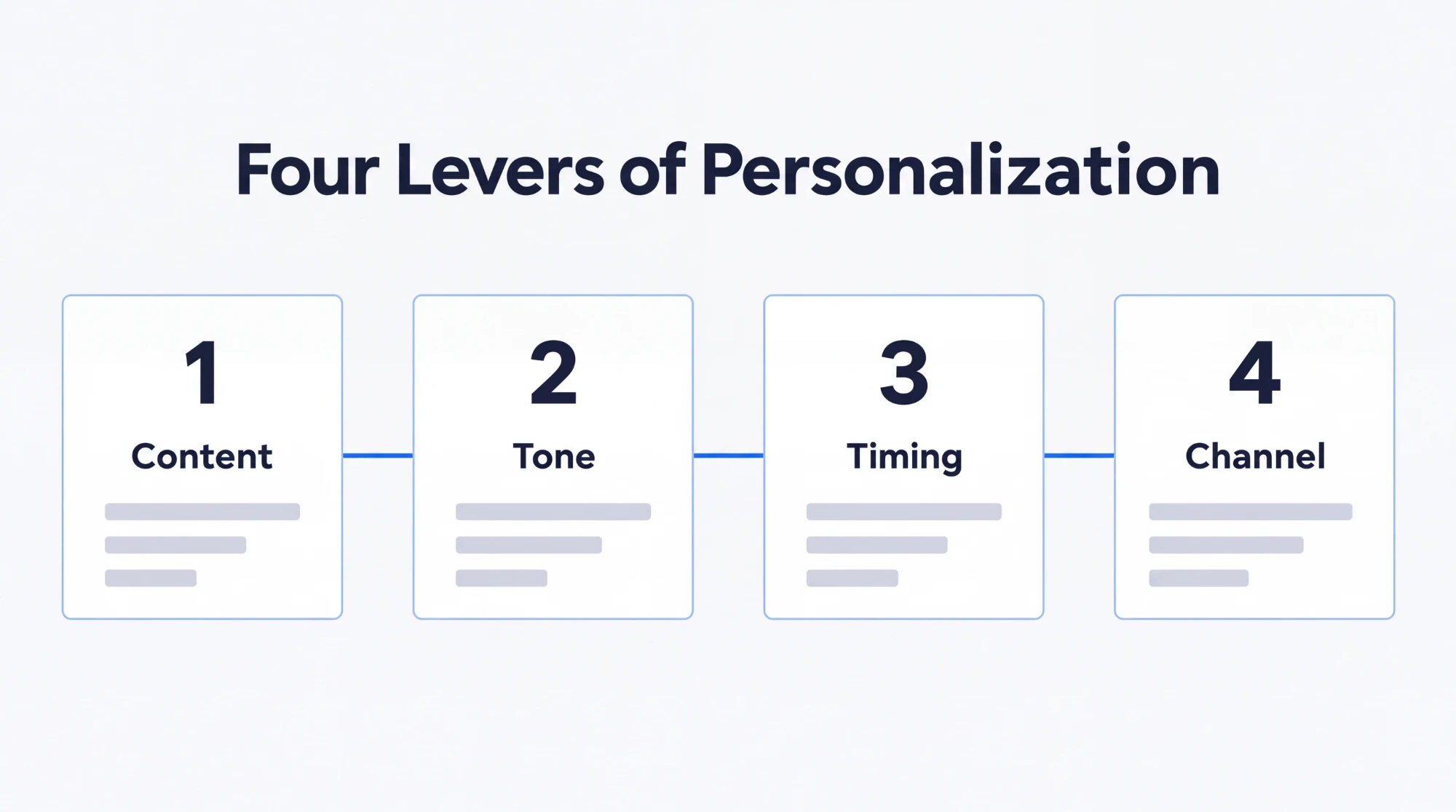
Token personalization touches none of these four levers. It just makes the first one — content — look more specific without actually changing what's being communicated.
Why “Personalized” AI Doesn't Automatically Fix This
The rise of generative AI in collections has made this problem easier to hide, not easier to solve. A general-purpose AI tool can draft a message that reads as warm, specific, and well-written — and still get the behavioral approach completely wrong, because tone and politeness aren't the same thing as behavioral fit. A message can be perfectly worded and still be the wrong message for that customer's actual situation: overly aggressive language sent to someone already under financial stress, or a gentle nudge sent to someone who's simply been putting off an easy task. Generic AI tools, trained for broad use cases rather than delinquency specifically, tend to default to one register for everyone — which means the personalization is cosmetic even when the writing quality is high.
There's a second failure mode: volume without relevance. It's easy for AI to generate more messages, across more channels, faster. But more messages built on the same generic understanding of the customer just accelerates the point at which that customer tunes out entirely. Quantity of outreach isn't personalization — it's often the opposite of it.
Higher recovery rates from Symend's behavioral science–driven engagement compared to legacy approaches — a gap that token-based personalization alone doesn't close.
What Real Personalization Looks Like at the Message Level
The clearest way to see the difference is at the individual message level, not the campaign level. Take a customer who's a few days past due on a bill. A token-personalized version might read: “Hi Sarah, your account is overdue. Please pay $123.12 to avoid late fees.” A behaviorally personalized version, built for a customer showing high capacity but low engagement, might instead lead with the specific consequence she's about to incur and offer the lowest-friction path to resolve it in one click — same balance, same due date, entirely different psychological approach. Neither message is “more true.” They're built for different customers, because different customers are, in fact, different.
This is also why personalization has to be dynamic rather than assigned once. A customer's situation shifts over the course of a delinquency episode — engagement patterns, payment attempts, and response to prior outreach all provide new signal. Enterprises that personalize once, at intake, and then run a fixed sequence are only ever as personalized as their first guess.
The Bottom Line
Enterprises that treat personalization as a data-merge problem are solving the easy 10% of the problem and calling it done. The harder, more valuable 90% is matching tone, timing, channel, and behavioral approach to why a specific customer hasn't engaged — which requires understanding capacity and readiness, not just contact information. SymendCure builds every customer journey around exactly that distinction, and SymendConverse carries the same behavioral read into live conversations, so personalization doesn't reset every time a customer switches channels.
Personalize for why, not just who
See how SymendCure matches tone, timing, channel, and behavioral approach to each customer's capacity and readiness. Estimate your savings, or book a 15-minute walkthrough.
TRY THE COST SAVINGS CALCULATOR REQUEST A DEMOKey Takeaways
- Token personalization is table stakes: Inserting a first name, balance, or due date into a template makes a collections message look more personal without changing what it says or how likely the customer is to respond.
- Real personalization is behavioral: It matches the tone, timing, channel, and behavioral approach of a message to why a specific customer hasn't paid, based on their financial capacity and psychological readiness to act.
- Four levers, not one: Content, tone, timing and cadence, and channel each need to adapt to the customer. Token personalization touches none of them.
- Generic AI can make it cosmetic: General-purpose generative AI writes warm, well-crafted messages but tends to apply one register to everyone — personalized in appearance, not in substance — and more volume accelerates tune-out.
- Personalization must stay dynamic: A customer's situation shifts across a delinquency episode, so effective approaches re-evaluate as engagement, payment attempts, and responses provide new signal.
Frequently Asked Questions
Real personalization means matching the tone, timing, channel, and behavioral approach of a message to why a specific customer hasn't paid — not just inserting their name or balance into a static template.
It's a form of it, but a less effective one. Token-based personalization changes how a message looks without changing what it says or how it's delivered, so two very different customers can still receive functionally the same message.
Enterprises assign customers to behavioral archetypes based on financial capacity and psychological readiness, then adapt tone, timing, channel, and behavioral tactics for each archetype — continuously refining the approach as the customer's situation evolves.
General-purpose generative AI can write well-crafted, warm-sounding messages, but without delinquency-specific behavioral science, it often applies the same tone or approach to every customer, which is personalized in appearance but not in substance.
Yes. A customer's engagement level and situation shift as a delinquency episode progresses, so personalization based only on the customer's initial profile becomes stale — effective approaches re-evaluate and adjust as new signals come in.