
Capacity vs. Readiness: The Two Questions a Risk Score Can't Answer
A risk score tells you how likely a customer is to default. It never tells you why — or what will actually get them to pay.

Key Takeaways
- A risk score ranks accounts by probability of default — it can't tell you why a customer isn't paying or what will move them to act.
- Two customers in the same risk band can differ completely on two hidden dimensions: capacity to pay and readiness to act.
- Plotting those two dimensions produces four Delinquency Archetypes (HCHR, HCLR, LCHR, LCLR), each needing a fundamentally different conversation.
- For financial services, the distinction changes recovery economics and protects the customer relationship — without relying on protected-class data.
- Capacity and readiness shift over time, so the archetype should be re-evaluated as new signals arrive — something static risk bands can't do.
Two customers land in the same risk band — same credit score range, same days-past-due, same balance. One pays within 48 hours of a single text reminder. The other goes silent for weeks despite five outreach attempts across three channels. The risk score didn't see this coming, because it was never built to. It told you how likely each customer was to default. It never told you why — and that's the question that actually determines what to do next.
This is the blind spot financial services collections teams run into every day: risk scores are excellent at ranking accounts by probability of loss, and genuinely bad at telling you what kind of engagement will move a specific customer to pay.
What can a risk score not tell you about a delinquent customer? A risk score can't tell you whether a customer has the financial capacity to pay right now, or whether they're psychologically ready to act. Two customers in the same risk band can have completely different combinations of capacity and readiness — and that combination, not the score itself, determines which message, tone, and offer will actually get them to resolve their balance.
What a Risk Score Actually Measures
Traditional risk scores are built on lagging indicators — credit history, past payment behavior, bureau data — compressed into a single probability of default. That's genuinely useful for portfolio-level decisions: how much to reserve, which accounts to prioritize for outreach, where exposure is concentrated. Even credit bureaus that build specifically for early-stage collections describe their scores as an index of "ability and willingness to pay" — implicitly acknowledging that a single number is standing in for two separate questions.
The problem shows up at the individual engagement level. A risk score can't distinguish between a customer who missed a payment because of a temporary cash flow gap and a customer who missed a payment because they're avoiding the situation entirely, even though they could pay today. Both might land in the same "medium risk" band. Both will get the same generic reminder, on the same cadence, in the same tone — and one of those customers will find that message completely irrelevant to their actual situation.
There's a second failure mode specific to AI-driven segmentation: models trained purely on historical scoring data tend to deliver a short-term lift and then plateau, because they're optimizing against the same lagging signals that made the original risk score incomplete in the first place. More data run through the same narrow lens doesn't answer a question the lens was never built to ask.
The Two Questions Risk Scores Miss
Underneath every risk band are two distinct, and often unrelated, dimensions:
Capacity to pay is the financial question — does this customer have the means to resolve their balance right now? Capacity can shift independently of credit history: a customer with a strong credit profile can be temporarily capacity-constrained by a job loss or unexpected expense, while a customer with a thinner credit file may have the cash on hand and simply hasn't gotten around to it.
Readiness to act is the psychological question — is this customer motivated and prepared to engage right now? Readiness is shaped by things a risk score has no visibility into: whether the customer feels shame or avoidance about the debt, whether they've had a frustrating past experience with collections, whether they're simply distracted and the bill has fallen off their radar.
A customer can be high on one dimension and low on the other, and the four resulting combinations require fundamentally different engagement — which is exactly what a single risk score, by design, can't represent.
The 2x2 Framework: Delinquency Archetypes
Plotting capacity and readiness against each other produces four behavioral archetypes, each driven by a different underlying psychological pattern:
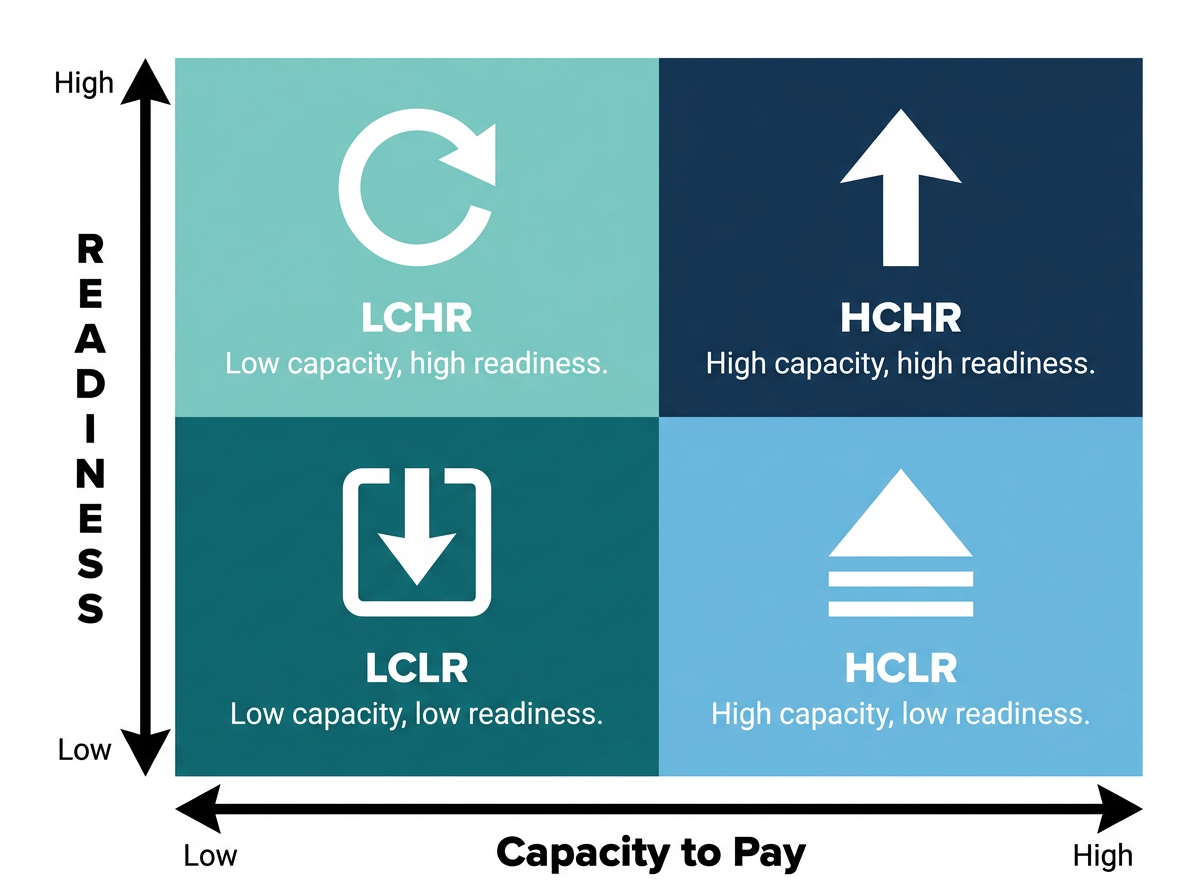
Two axes — capacity to pay and readiness to act — produce four archetypes, each needing a different conversation.
- HCHR — High Capacity, High Readiness. These customers can pay and want to resolve things quickly. Their behavior is often driven by uncertainty avoidance: they dislike not knowing where things stand, so a clear, low-friction path to resolution is usually all it takes.
- HCLR — High Capacity, Low Readiness. These customers can pay but are delaying. Often shaped by a decision-from-experience gap — past experience paying just before serious consequences hit has taught them delinquency is lower-risk than it actually is. The fix isn't more information; it's reframing the real cost of continued delay.
- LCHR — Low Capacity, High Readiness. These customers want to resolve their balance but don't have the means right now. Motivated by goal approach — they're actively working toward resolution despite constraints, and respond well to structured support like payment plans that make progress visible.
- LCLR — Low Capacity, Low Readiness. These customers are constrained on both dimensions, often experiencing tunneling amid scarcity: financial stress narrows their focus so much that addressing the debt drops off their radar entirely, even when they intend to deal with it. They need empathetic, simplified engagement that reduces the cognitive load of taking action.
Spelling out the full names matters here, because the acronyms alone can blur together — but each one is really just a plain-language answer to two questions: can this customer pay, and do they want to engage right now. High Capacity, High Readiness customers can and will. High Capacity, Low Readiness customers can but won't yet. Low Capacity, High Readiness customers will but can't yet. Low Capacity, Low Readiness customers are stuck on both fronts. That plain-language version is often more useful in practice than the acronym, especially when explaining the framework to stakeholders outside the collections team.
"The same $200 past-due balance, in four different customers, can require four completely different conversations — and a risk band alone will never tell you which one you're having."
Why This Matters Especially for Financial Services
Financial institutions have more reason than most to get this right. Credit card and loan portfolios carry regulatory scrutiny that telecom and utility collections don't face in the same way — which makes it worth being explicit about what archetype-based segmentation is, and isn't. It's not built on protected-class attributes like age, race, or zip code; it's built on financial and behavioral signals — payment history, engagement patterns, account tenure — the same category of data risk models already use, just applied to a different question. The goal isn't to treat customers differently based on who they are; it's to stop treating customers identically when their actual situations are different.

For financial services collections leaders, that distinction matters for two reasons: it changes recovery economics, and it protects the customer relationship. A high-capacity, low-readiness cardholder who gets nudged out of avoidance with the right reframe stays a customer. The same cardholder, treated identically to a genuinely capacity-constrained one and sent five generic reminders, is far more likely to churn even after the balance is resolved.
ROI at a major North American bank that segmented past-due customers behaviorally rather than by risk band alone — saving $25M+, with a 6% early-stage cure-rate lift and a 23% reduction in early-stage roll rates.
From Static Bands to Adaptive Segmentation
Capacity and readiness aren't fixed at the moment a customer becomes delinquent — they shift as the situation evolves, and a customer's archetype should shift with them. A customer who doesn't engage with an initial high-readiness message may, in fact, have lower readiness than first assessed; a customer who accepts a payment plan and then misses it may need a different kind of support than the one that got them there. Static, point-in-time risk bands can't capture that movement. Behavioral models built to re-evaluate customers as new signals arrive can — the same shift from prediction to behaviorally driven delinquency management that separates a plateau from a compounding result.
The Bottom Line
A risk score answers a portfolio question: how much exposure do we have, and where. It was never built to answer the individual question that actually drives recovery: what does this specific customer need to hear, from whom, in what tone, to act. Capacity and readiness fill that gap. SymendCure builds engagement around exactly this framework for financial services portfolios — scoring customers on both dimensions and adapting tone, timing, and offer as their situation changes, rather than treating an entire risk band the same way. It's the same behavioral model behind how enterprises are using behavioral science across collections.
If you want to see how your portfolio's risk bands break down by capacity and readiness, see how the Symend platform works or estimate the impact for your own book.
See your risk bands broken down by capacity and readiness
Move past a single default probability to the two dimensions that decide what actually recovers a balance. Estimate the impact for your portfolio, or book a 15-minute demo.
TRY THE COST SAVINGS CALCULATOR REQUEST A DEMOKey Takeaways
- A risk score answers a portfolio question, not an engagement one: It ranks accounts by probability of default. It cannot tell you whether a customer has the means to pay right now, or whether they are psychologically ready to act.
- What behavioral segmentation delivered at a major North American bank: An 11x ROI and over $25M saved, with a 6% early-stage cure-rate lift and a 23% reduction in early-stage roll rates.
- Two dimensions, four archetypes, four different conversations. Capacity to pay crossed with readiness to act produces HCHR, HCLR, LCHR and LCLR — built on financial and behavioral signals, not protected-class attributes, and re-evaluated as new signals arrive rather than fixed at the moment of delinquency.
- Behavioral science defines the variables, data science defines the methodology, and the platform executes. Proprietary Delinquency Archetypes decode each customer's capacity to pay and readiness to act, delivering empathetic, personalized outreach that resolves accounts and preserves the relationship.
Frequently Asked Questions
A risk score can't tell you whether a customer currently has the financial capacity to pay or whether they're psychologically ready to act. Two customers in the same risk band can have very different combinations of capacity and readiness, which determines what kind of outreach will actually work.
Capacity to pay is a financial question — does the customer have the means to resolve their balance right now. Readiness to act is a psychological question — is the customer motivated and prepared to engage right now. A customer can be high on one and low on the other.
Risk scoring produces a single probability of default based on lagging indicators like credit history. Archetype segmentation adds a second, independent dimension — psychological readiness — and uses both to determine engagement strategy, not just collections priority.
No. Archetype models are built on financial and behavioral signals — payment history, engagement patterns, account tenure — not demographic or protected-class attributes.
Documented outcomes for financial-institution credit card and loan portfolios include cure-rate lifts in the mid-single-digit percentage range (several hundred basis points), meaningful reductions in roll rates, and strong ROI. For example, a major North American bank saved $25M+ at an 11x ROI, with a 6% early-stage cure-rate lift and a 23% reduction in early-stage roll rates. Actual results vary by portfolio type and starting baseline.