
How Symend Supports CFPB and Regulation F Compliance in Digital Collections
Regulation F sets specific, measurable limits on how and how often a debt collector may contact a consumer. Symend is technology that enterprises use inside their own collections programs. It supports a client's compliance obligations; it does not assume them. Compliance under the Fair Debt Collection Practices Act and Regulation F rests with the entity collecting the debt.
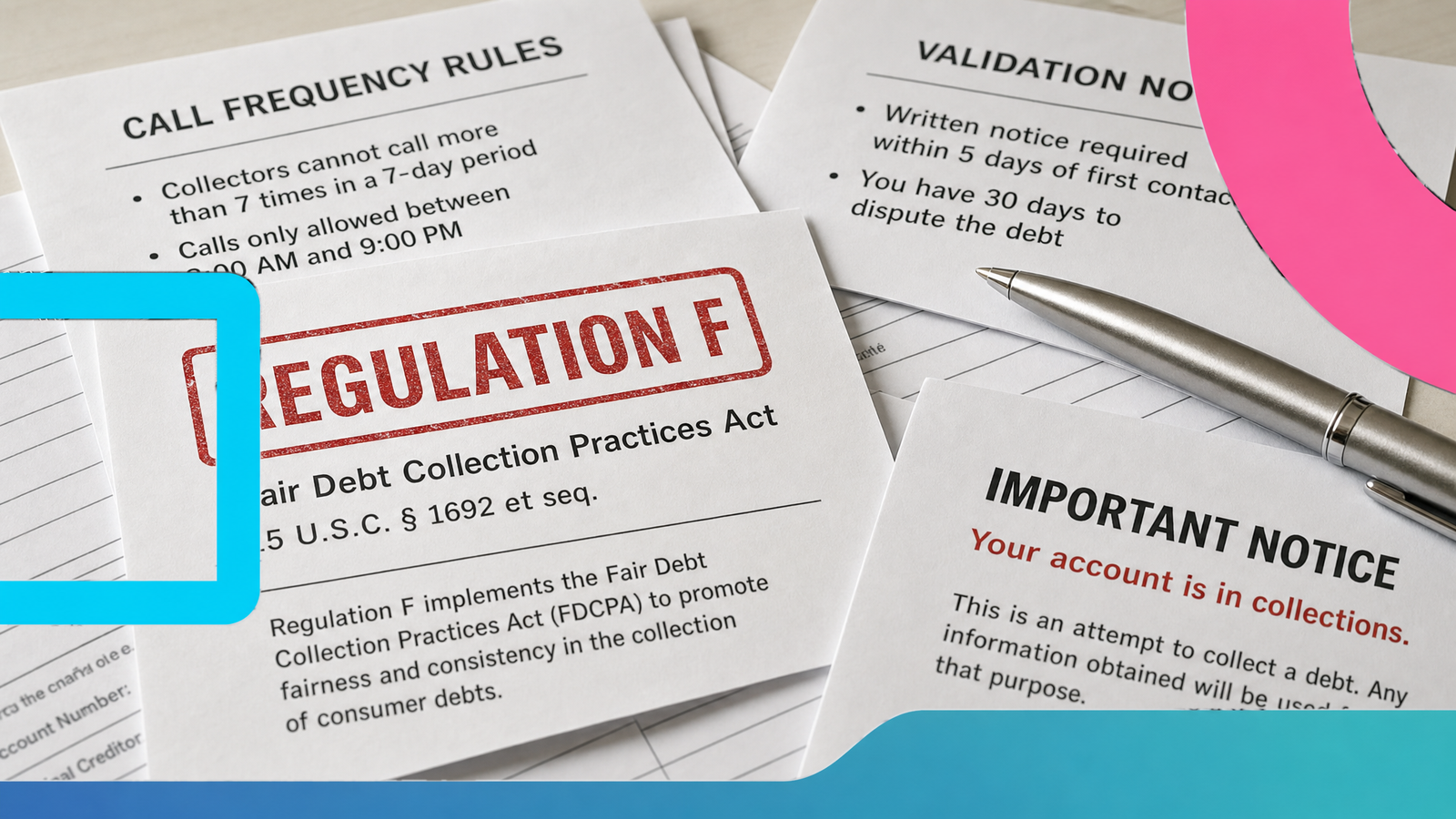
What Regulation F actually requires
Regulation F is the Consumer Financial Protection Bureau's rule implementing the Fair Debt Collection Practices Act. It took effect on November 30, 2021, and was the first substantive rulemaking under the FDCPA since the statute was enacted in 1977. Where the FDCPA set broad standards — no harassment, no false or misleading representations, no unfair practices — Regulation F converts several of those standards into countable rules: how many telephone calls, within what period, carrying what disclosures, through which channels, and with what mechanism for a consumer to stop them.
Scope matters before anything else. Regulation F applies to "debt collectors" as that term is defined in the FDCPA — broadly, parties collecting debts owed to another, and creditors who collect their own debts under a name other than their own. A creditor collecting its own debts in its own name generally falls outside that definition. That carve-out is why first-party and third-party collections programs operate under different obligations. It is not, however, a reason for a first-party operation to disregard the rule. Creditors that place accounts with third-party agencies carry vendor oversight responsibilities that require them to understand it. The Bureau's authority over unfair, deceptive or abusive acts and practices reaches first-party conduct that Regulation F does not. State collection statutes frequently reach further than the federal rule. And many first-party operations adopt Regulation F's contact standards as internal policy because the alternative is running two different standards of consumer treatment across the same portfolio.
The practical problem for most enterprises is that their collections technology predates the rule. Dialers, campaign management tools and marketing automation platforms were designed when contact volume was the thing to maximize — more attempts, more channels, more coverage. Regulation F made frequency a governed variable rather than a throughput one, and it did so per debt rather than per customer, which most campaign tools have no concept of. The result across the industry is a compliance layer bolted on after the fact: suppression lists maintained outside the system that sends the messages, frequency counters that live in a different platform from the dialer, and disclosure logic hand-maintained in message templates. Each of those seams is a place where a defensible program becomes undefensible under examination.
Contact frequency limits and the seven-in-seven rule
What the rule says
The frequency provision sits at 12 CFR § 1006.14(b). It operates as a rebuttable presumption rather than an absolute ceiling, which is the detail most summaries omit. A debt collector is presumed to comply with the prohibition on repeated or continuous telephone calls if it places calls to a particular person about a particular debt neither:
- more than seven times within seven consecutive days; nor
- within seven consecutive days after having had a telephone conversation with that person about that debt, counting the date of the conversation as the first day of the seven-day period.
Exceeding either prong does not automatically establish a violation, and staying inside both does not make a program immune — the presumption can be rebutted in either direction on the facts.
The counting unit is the debt, not the consumer
Section 1006.14(b) counts per particular debt. A consumer with three accounts in collection carries three separate counters. Telephone numbers do not multiply the allowance: the limit applies per person, per debt, across every number on file, so eight calls placed to eight different numbers about one debt is eight calls. A single telephone conversation that covers several debts starts the seven-day period for every debt discussed.
Which attempts count
Section 1006.14(b)(3) excludes certain calls from the frequency counts:
- calls placed with the consumer's direct prior consent — consent that is valid for a maximum of seven days, even where the consumer agrees to a longer period;
- calls that do not connect to the dialed number;
- calls placed to specified parties rather than the consumer, including the consumer's attorney, a consumer reporting agency, the creditor, the creditor's attorney and the debt collector's attorney.
A call that connects counts, whether or not anyone answers. The Bureau's Debt Collection Rule FAQs confirm there is no exclusion for limited-content messages: a call that leaves one still counts toward the frequency limits.
Limited-content messages
A limited-content message, defined at 12 CFR § 1006.2(j), is a voicemail for a consumer that carries only prescribed content. It is not a "communication" under the rule, which is what allows it to be left without triggering third-party disclosure concerns. To qualify, it must include a business name for the debt collector that does not indicate the collector is in the debt collection business, a request that the consumer reply, the name of one or more natural persons the consumer can contact, and a telephone number for that reply. A short list of optional additions is permitted at § 1006.2(j)(2). Any other content that directly or indirectly conveys information about a debt disqualifies the message.
Email, text message and time-of-day restrictions
The frequency caps at § 1006.14(b) govern telephone calls. Email and text messages are not counted under that provision; they are governed elsewhere in the rule.
Section 1006.6(d) sets out procedures a debt collector can follow to establish a safe harbor when using a consumer's email address or a telephone number for text messages, built around how the address or number was obtained and whether the consumer has since opted out. Where an opt-out notice is used to establish that safe harbor, § 1006.6(d)(4)(ii)(C) requires the notice to state a date for receiving the consumer's opt-out request that is at least 35 days after the notice is sent.
Section 1006.6(e) applies to every electronic communication or attempt: each one must carry a clear and conspicuous statement describing a reasonable and simple method for the consumer to opt out of further electronic communications to that address or number. The official interpretations are specific about what qualifies — a hyperlink, or replying with the word "stop," is reasonable and simple. Requiring a consumer who received the notice electronically to opt out by postal mail, by telephone, or by visiting a website without a link provided does not qualify. Once a consumer opts out of a medium, § 1006.14(h) prohibits further communication or attempted communication through it.
Time-of-day restrictions apply across channels, not only to calls. Absent the consumer's consent or knowledge of different circumstances, before 8:00 a.m. and after 9:00 p.m. in the consumer's local time is treated as an inconvenient time to communicate.
Validation notices and required disclosures
Under 12 CFR § 1006.34, a debt collector must provide the consumer with validation information either in its initial communication or within five days of that initial communication — by sending a validation notice in the manner § 1006.42 requires, or by providing the validation information orally in the initial communication. The requirement falls away if the consumer pays the debt before the deadline for sending it.
Section 1006.34(b)(5) defines the validation period as beginning when the validation information is provided and ending 30 days after the consumer receives it or is assumed to receive it. The notice itself must state that end date, which means the collector has to calculate it at the time of sending, from the date of assumed receipt. During that period, the collector must not engage in collection activity or communications that overshadow or are inconsistent with the disclosure of the consumer's right to dispute the debt and to request the original creditor's name and address.
Separately, § 1006.18(e) requires the initial communication to disclose that the debt collector is attempting to collect a debt and that any information obtained will be used for that purpose. The Bureau publishes a model validation notice; using it provides a safe harbor for the content and format of the disclosures.
Two operational consequences follow, and they are where engagement platforms usually create risk rather than reduce it. First, the validation period is a window in which the tone and content of every other message matters, not just its frequency — an urgent payment prompt sent during that window can overshadow the dispute disclosure even though nothing about it exceeds a contact limit. Second, the end date is account-specific and derived from assumed receipt, so a campaign scheduled on calendar logic rather than per-account validation state will eventually send the wrong message on the wrong day.
What a defensible audit trail has to contain
The question an examiner asks is narrow and specific: why did this customer receive this message, on this channel, at this time? Answering it requires more than a send log. A complete record has to reconstruct the decision, which means holding, for a single outbound message: the account and debt it related to; the data inputs available at the moment of the decision; how the customer was classified and on what signals; which engagement strategy was selected and why that one; the channel, timing and content chosen; the contact-eligibility and consent state that applied at send time; and the outcome. It also has to be retrievable months later, at the level of one customer, by someone who was not involved in building the system.
Most platforms can produce the first and last of those. The middle — the reasoning — is where systems fail, because the decision was never represented in a form that can be retrieved. Any organization evaluating engagement technology for a regulated collections program should ask for a worked example: one real customer, one message, the full chain from input to outcome. A vendor that needs engineering time to assemble that after the fact does not have an audit trail; it has logs. We have written about that distinction in more depth in glass box versus black box AI governance in collections.
Reducing consumer harm at the source
Regulation F limits how often a customer can be contacted. It does not say anything about whether the contact should have been made at all, or whether it was the right message. A program can sit comfortably inside every limit in the rule and still generate the outcome the rule exists to prevent: a customer contacted repeatedly with messages that do not fit their situation, who disengages, complains, or stops opening anything from the brand.
That distinction matters supervisorily as well as ethically. Consumer complaints are a signal regulators act on, and they are generated by experience rather than by rule violations. A compliance program built only on contact ceilings is measuring the wrong thing.
This is where behavioral science and compliance point in the same direction rather than pulling against each other. Symend's Delinquency Archetypes classify customers on two dimensions — capacity to pay and readiness to act — rather than on risk of default alone. A customer who intends to pay but cannot this month needs different treatment from one who can pay but has not engaged, and neither is served by another reminder. Matching the message to the reason someone has not paid reduces the number of contacts required to resolve an account, and a message that fits does not need to be repeated as often. Lower contact volume is not only an efficiency outcome; it is a smaller surface for the complaints and conduct findings that contact ceilings alone do not prevent.
Multi-channel engagement built on that foundation is delivered through SymendCure, and applied across regulated industries including telecommunications, financial services and utilities. Symend maintains SOC 2 Type II and ISO 27001 certification, and the platform is built to meet GDPR and CCPA data protection requirements.
Operating across jurisdictions
Symend operates across the United States, Canada and the United Kingdom. The engagement engine is the same in each market; the rule set it is configured against is not. Contact eligibility, consent handling, disclosure requirements and permitted channels are market-specific configuration, not product variants.
Regulation F governs the United States and is the subject of this page. Canadian programs operate under federal privacy legislation including PIPEDA, Quebec's Law 25 where applicable, and provincial collection practice statutes that differ by province. United Kingdom programs operate under the Financial Conduct Authority's Consumer Credit sourcebook and the Consumer Duty. Those regimes impose different obligations from Regulation F and from each other, and they are not covered here. We will address them separately rather than summarizing three frameworks at a depth that would serve none of them.
Key Takeaways
- Regulation F applies to debt collectors, not to every collections program: It reaches parties collecting debts owed to another, and creditors collecting under a name other than their own. A creditor collecting its own debts in its own name generally falls outside it — though UDAAP authority, state statutes and vendor oversight obligations still reach that conduct.
- The seven-in-seven rule is a presumption, not a ceiling: Under 12 CFR § 1006.14(b), a collector is presumed to comply if it places no more than seven calls within seven consecutive days about a particular debt, and none within seven days of a telephone conversation about it. The counting unit is the debt, not the customer, and phone numbers do not multiply the allowance.
- Contact ceilings do not address the complaint surface: A program can sit inside every limit in the rule and still generate the outcome the rule exists to prevent. Engagement built around a customer's capacity to pay and readiness to act resolves accounts with less outreach. Symend supports a client's compliance program; the compliance obligation remains the client's.
- Behavioral science defines the variables, data science defines the methodology, and the platform executes. Proprietary Delinquency Archetypes decode each customer's capacity to pay and readiness to act, delivering empathetic, personalized outreach that resolves accounts and preserves the relationship.
Frequently Asked Questions
Compliance under the Fair Debt Collection Practices Act and Regulation F attaches to the entity collecting the debt, not to the software it uses. Symend is not a debt collector and does not collect debts. It is an engagement platform that enterprises operate inside their own collections programs, configured against the contact rules, consent state and disclosure requirements that apply to that client in that market. Symend supports a client's compliance program. It does not make a client compliant, and no vendor can.
Generally, no. Regulation F applies to "debt collectors" as defined in the FDCPA — broadly, parties who collect debts owed to another, and creditors who collect their own debts under a name other than their own. A creditor collecting its own debts in its own name usually falls outside that definition. That does not put first-party collections outside regulation: the CFPB's authority over unfair, deceptive or abusive acts and practices reaches first-party conduct, state collection statutes often apply, and creditors placing accounts with third-party agencies carry vendor oversight obligations that require them to understand Regulation F. Many first-party operations also adopt its contact standards as internal policy.
The seven-in-seven rule is shorthand for the telephone call frequency provision at 12 CFR § 1006.14(b). A debt collector is presumed to comply with the prohibition on repeated or continuous calls if it places no more than seven telephone calls to a person about a particular debt within seven consecutive days, and places no call within seven consecutive days after having had a telephone conversation with that person about that debt. It is a rebuttable presumption rather than a hard cap, and the counting unit is the individual debt rather than the consumer, so a consumer with multiple accounts in collection carries multiple counters. Calls that do not connect are excluded, as are calls placed with the consumer's direct prior consent, which is valid for a maximum of seven days.
Yes. Regulation F expressly contemplates email and text message collection communications and sets conditions on them. Section 1006.6(d) establishes procedures a collector can follow to obtain a safe harbor for using a given email address or text number, based on how it was obtained and whether the consumer has opted out. Section 1006.6(e) requires every electronic communication or attempt to include a clear and conspicuous statement describing a reasonable and simple way to opt out — a hyperlink or a "stop" reply qualifies; requiring postal mail or an unlinked website does not. The telephone call frequency limits at § 1006.14(b) do not count email or text messages, but time-of-day restrictions apply across channels.
Talk to us about your compliance requirements
Every collections program operates under a different combination of federal rules, state statutes and internal policy. If you are evaluating how a behavioral engagement layer would fit inside yours, our team can walk through the specifics with your compliance stakeholders.
Request a Demo