Collections Compliance: What Compliance Teams Should Require From a Platform
Seven controls compliance teams should require when evaluating a collections platform — from contact-frequency governance to a retrievable audit trail — and what no platform can do for you.

Key Takeaways
- Compliance teams evaluating a collections platform should require controls, not promises: what the platform has to do, not which statute it names.
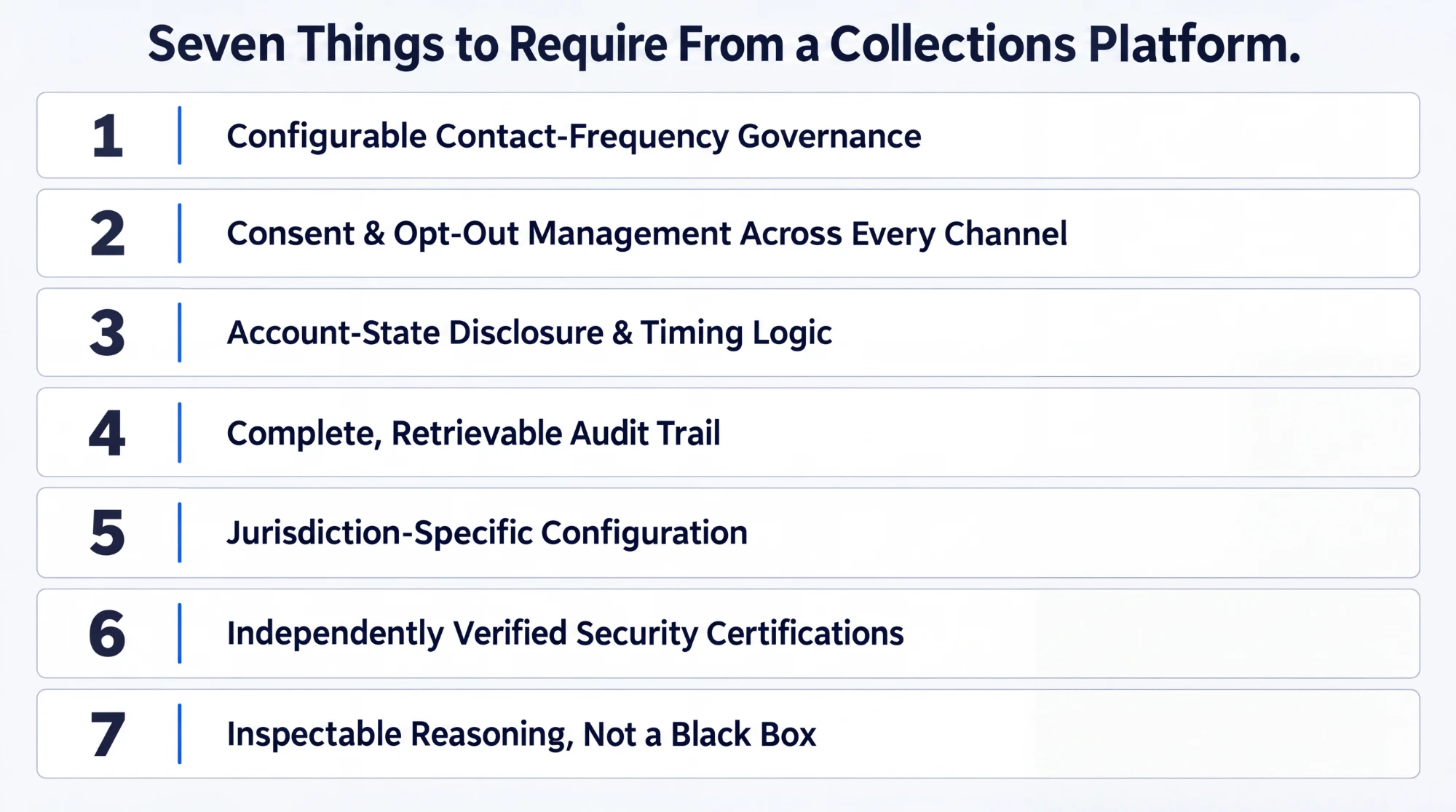
- Seven categories belong in any RFP: contact-frequency governance, cross-channel consent and opt-out, account-state disclosure and timing logic, a retrievable audit trail, jurisdiction-specific configuration, independently verified security certifications, and inspectable reasoning.
- A defensible audit trail explains why a customer received a given message, on a given channel, at a given time — not just that it was sent.
- A platform supports a compliance program; it does not assume the compliance obligation. That stays with the entity collecting the debt.
Compliance teams evaluating a collections platform rarely search for a specific regulation by name. They search for what the platform has to do: enforce contact limits, manage consent, produce an audit trail an examiner can follow, and hold up under scrutiny it wasn't specifically built to anticipate. This post is written from that side of the table — what a compliance team should require in a vendor evaluation, not a walkthrough of the statute.
One framing point before anything else: a collections platform is technology an enterprise operates inside its own collections program. It can support that program with controls, configuration, and documentation. It cannot assume the compliance obligation itself, and no vendor claiming otherwise should be trusted on the rest of its claims either. The obligation stays with the entity collecting the debt.
What is the best debt collection platform for compliance teams?The best fit is a platform that lets compliance teams configure contact-frequency limits per debt, manage consent and opt-out per channel, apply disclosure and timing logic per account rather than by calendar, produce a complete and retrievable audit trail, and configure rules per jurisdiction — backed by independently audited security certifications. No platform makes an organization compliant on its own; it supports the compliance program the organization builds and owns.
What to Require From a Platform
Seven categories of control belong in any RFP or vendor evaluation for a regulated collections program:
1. Configurable contact-frequency governance
The platform should let compliance teams configure contact limits per debt, not just per customer or per campaign — since a customer with multiple accounts in collection can carry separate limits for each one. Limits should be enforceable at the point of send, not reconciled after the fact against a suppression list maintained somewhere else.
2. Consent and opt-out management across every channel
Email and text communications carry their own consent and opt-out mechanics, separate from call frequency. A platform should track consent state per channel per customer, honor opt-outs immediately and permanently for that channel, and make the opt-out mechanism itself simple — a link or a one-word reply, not a process that requires the consumer to call in or find an unlinked web form.
3. Time and disclosure logic tied to account state, not a calendar
Validation periods, required disclosures, and inconvenient-contact-time restrictions are account-specific, not campaign-specific. A platform scheduled purely on calendar logic will eventually send the wrong message on the wrong day for a given account. Compliance teams should require that this logic be evaluated per account at send time, not baked into a fixed campaign sequence.
4. A complete, retrievable audit trail — not just a send log
The question an examiner asks is specific: why did this customer receive this message, on this channel, at this time? Answering it requires more than proof that a message went out. Compliance teams should require the platform to reconstruct, for any single message, months after the fact: the data available at the moment of the decision, how the customer was classified, which strategy was selected and why, the consent and eligibility state that applied, and the outcome — retrievable by someone who wasn't involved in building the system. A vendor that needs engineering time to assemble that after the fact has logs, not an audit trail.
5. Jurisdiction-specific configuration, not one-size-fits-all logic
An enterprise operating across multiple states, provinces, or countries needs contact rules, consent handling, and disclosure requirements configured per jurisdiction — not a single global ruleset applied everywhere and hoped to be conservative enough. Compliance teams should require the platform to treat jurisdiction as a first-class configuration input, not an afterthought handled through manual overrides.
6. Independently verifiable security and data-handling certifications
Data protection sits alongside contact-practice compliance rather than replacing it. Compliance teams should require current, independently audited certifications — SOC 2 Type II and ISO 27001 are the baseline most enterprise programs expect — along with a documented approach to frameworks like GDPR and CCPA where applicable, rather than a vendor's own assurance that data handling is “secure.”
7. Inspectable reasoning, not a black box
A system that can show its send log but not its reasoning creates the same audit gap as no system at all. Compliance teams should require a worked example during evaluation — one real customer, one message, the full chain from input to outcome — before assuming the platform's decisioning is defensible under examination.
What a Platform Cannot Do for You
None of the above transfers the compliance obligation to the vendor. A platform can enforce configured limits, log decisions, and support consistent execution of a program compliance teams design and own. It cannot replace legal counsel's judgment on what those limits should be in a given jurisdiction, and it cannot certify that an enterprise's overall program is compliant — that determination belongs to the compliance team and counsel, informed by their own risk assessment and examination history.
Symend is technology that enterprises use inside their own collections programs. It supports a client's compliance obligations; it does not assume them. Compliance under the Fair Debt Collection Practices Act, Regulation F, and equivalent frameworks in other markets rests with the entity collecting the debt.
— Symend company materialsWhere This Fits With the Regulatory Detail
This post covers what to require at the evaluation stage. For the statute-level detail — contact-frequency provisions, validation notice timing, limited-content message requirements, and how Symend's platform is configured against them — see “How Symend Supports CFPB and Regulation F Compliance in Digital Collections.”
If your compliance stakeholders want to walk through how SymendCure is configured against your specific jurisdictions and requirements, request a demo and our team can go through it directly with them.
Bring your compliance team to the demo
Walk through how SymendCure is configured against your jurisdictions and requirements, or read the statute-level detail on Regulation F.
REQUEST A DEMO REGULATION F DETAILKey Takeaways
- Require controls, not claims: Compliance teams should evaluate a collections platform on what it has to do — enforce contact limits, manage consent, apply account-specific timing, and produce an audit trail an examiner can follow.
- Seven categories of control: Configurable contact-frequency governance, cross-channel consent and opt-out management, account-state disclosure and timing logic, a complete and retrievable audit trail, jurisdiction-specific configuration, independently verified security certifications, and inspectable reasoning.
- Audit trail, not a send log: For any single message, the platform should reconstruct the data available, how the customer was classified, which strategy was selected and why, the consent and eligibility state, and the outcome — months later, without engineering help.
- The obligation stays with the collector: A platform supports a compliance program with controls, configuration, and documentation; it cannot replace legal counsel's judgment or certify that a program is compliant.
Frequently Asked Questions
The best fit is a platform that lets compliance teams configure contact-frequency limits per debt, manage consent and opt-out per channel, apply disclosure and timing logic per account rather than by calendar, produce a complete and retrievable audit trail, and configure rules per jurisdiction — backed by independently audited security certifications. No platform makes an organization compliant on its own; it supports the compliance program the organization builds and owns.
Seven categories matter most: configurable contact-frequency governance, cross-channel consent and opt-out management, account-specific disclosure and timing logic, a complete and retrievable audit trail, jurisdiction-specific configuration, independently verified security certifications, and inspectable decision reasoning rather than a black-box system.
No. A collections platform is technology an organization operates inside its own compliance program. It can enforce configured controls and produce documentation that supports the program, but the compliance obligation itself remains with the entity collecting the debt, and legal counsel's judgment on program design cannot be replaced by any vendor's technology.
For any single outbound message, a defensible audit trail should reconstruct the data available at the moment of the decision, how the customer was classified, which engagement strategy was selected and why, the consent and eligibility state that applied at send time, and the outcome — retrievable months later by someone who was not involved in building the system.
Contact rules, consent handling, and disclosure requirements vary by state, province, and country. A platform serving a multi-jurisdiction enterprise should treat jurisdiction as a first-class configuration input — applying the correct rule set per account based on where that customer is located — rather than applying a single global ruleset or relying on manual overrides.