Why You Can't Build Behavioral Collections on Blaze and Marketing Cloud
A rules engine decides who to treat. Marketing Cloud decides when to send. Neither is built to change what a past-due customer actually does — here's where the gap opens up.

Key Takeaways
- A common enterprise collections stack pairs FICO Blaze Advisor (decisioning) with Salesforce Marketing Cloud (delivery). Both are excellent at their jobs — neither was built for behavioral engagement with financially stressed customers.
- Marketing Cloud optimizes for opens and clicks; in collections the outcome is payment, and the two can move in opposite directions.
- A rules engine can only execute hypotheses someone already wrote, and it segments on attributes of the debt, not the person.
- Compliance logic and the learning loop both get split across the seam between the two systems, so learning slows to a batch cadence.
- The fix isn't a rip-and-replace — it's adding the behavioral layer between decisioning and delivery that decides what to say and learns from whether it worked.
It's one of the most common answers we hear when we ask an enterprise collections team how they run past-due engagement: FICO Blaze Advisor decides which accounts get which treatment, and Salesforce Marketing Cloud delivers the message across email, SMS and push. On a slide, that looks complete. Something decides, something sends.
The bill of materials is right. The architecture isn't. Between the system that decides who to contact and the system that delivers when, there's a question neither Blaze nor Marketing Cloud was built to answer — what do you say to someone who is behind on a bill, and why would it change what they do? This post walks through five places that gap opens up, what it costs, and what to do about it without tearing either platform out.
What Blaze and Marketing Cloud were actually designed for
It's worth being precise, because both platforms are genuinely good at their jobs.
Blaze Advisor is a decisioning layer. It gives business users rulesets, scorecards, decision tables and trees, supports models via PMML, Python, R and SAS, and provides audit logging and champion/challenger testing. Because rules are explicit and versioned, a compliance team can reconstruct exactly why a given account was treated a given way. In a regulated collections operation, that traceability is not optional.
Marketing Cloud is a delivery layer. Journey Builder orchestrates email, SMS, WhatsApp and push at enterprise volume, and the 2026 releases have pulled Flow, Campaigns, Agent Builder and unified analytics into the same environment. For deliverability and cross-channel coordination at scale, it's a serious piece of infrastructure.
Neither was designed for behavioral engagement with financially stressed customers. That's not a criticism. It's a scope statement.
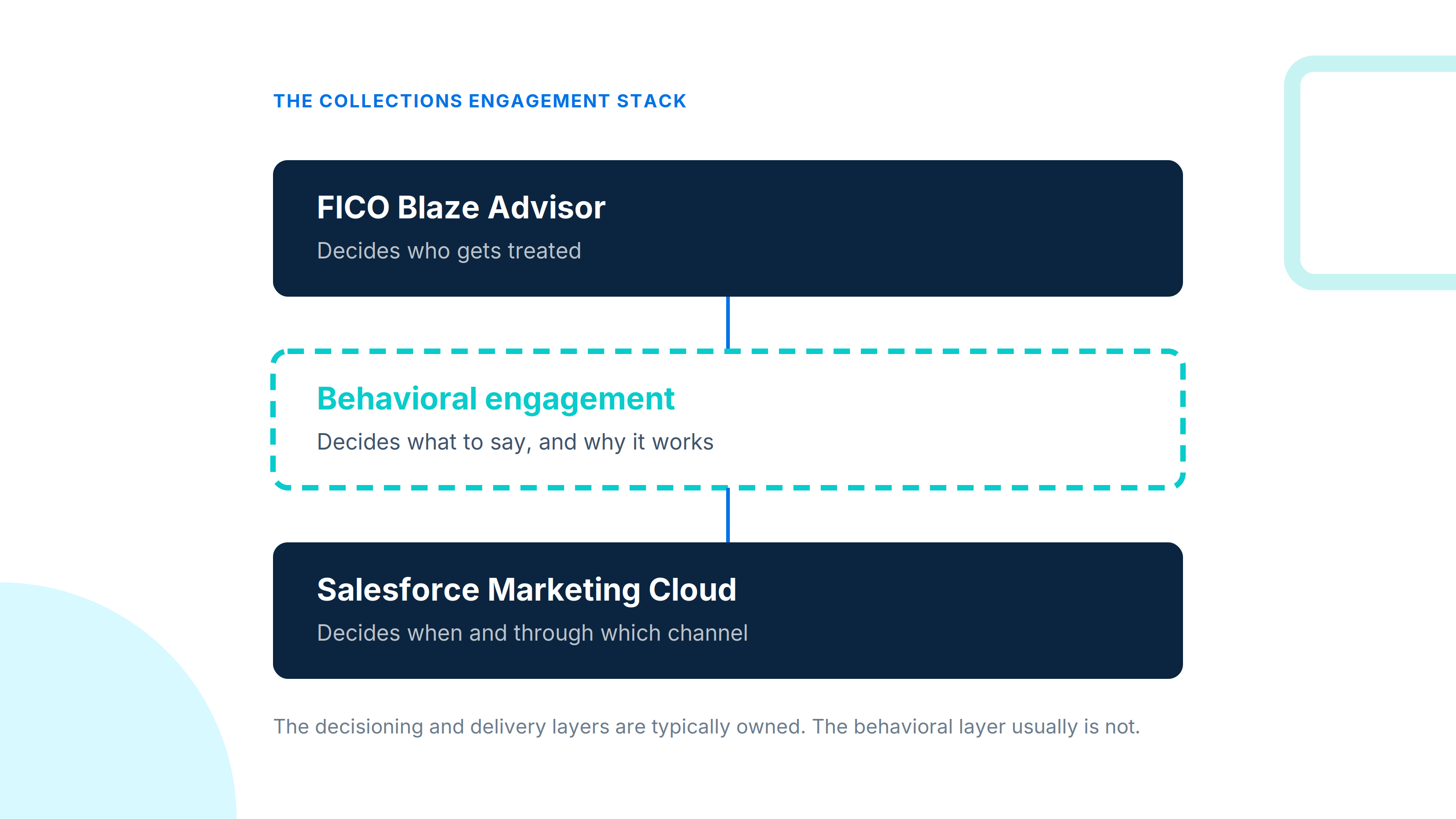
The decisioning and delivery layers are typically owned. The behavioral layer between them usually isn't.
1. Marketing Cloud optimizes for the wrong outcome
This is the one that costs the most and gets noticed the least.
Marketing Cloud's Einstein Send Time Optimization analyzes 90 days of per-contact engagement — opens, clicks, time-of-day patterns — and produces an engagement-likelihood score for each of the 168 hours in a week. It's a well-built model. It is optimizing for opens.
In collections, an open is not the outcome. A payment is. Those two things can move in opposite directions: a message that reliably gets opened can also trigger psychological reactance — the instinctive resistance people feel when they sense they're being pressured — and produce an opened, clicked, unpaid account. The system scores that as a win.
There's a timing problem underneath it. Send Time Optimization is evaluated once per week, and a contact needs opens or clicks in the prior 90 days to qualify. Delinquency moves in days. And the customers who most need reaching are disengaged by definition — the ones with no recent open history fall back to a generalized model calibrated on average behavior. The population where personalization matters most is precisely the population the model can't personalize for.
"A message that gets opened, clicked, and produces no payment is scored as a success by every engagement metric your marketing platform reports."
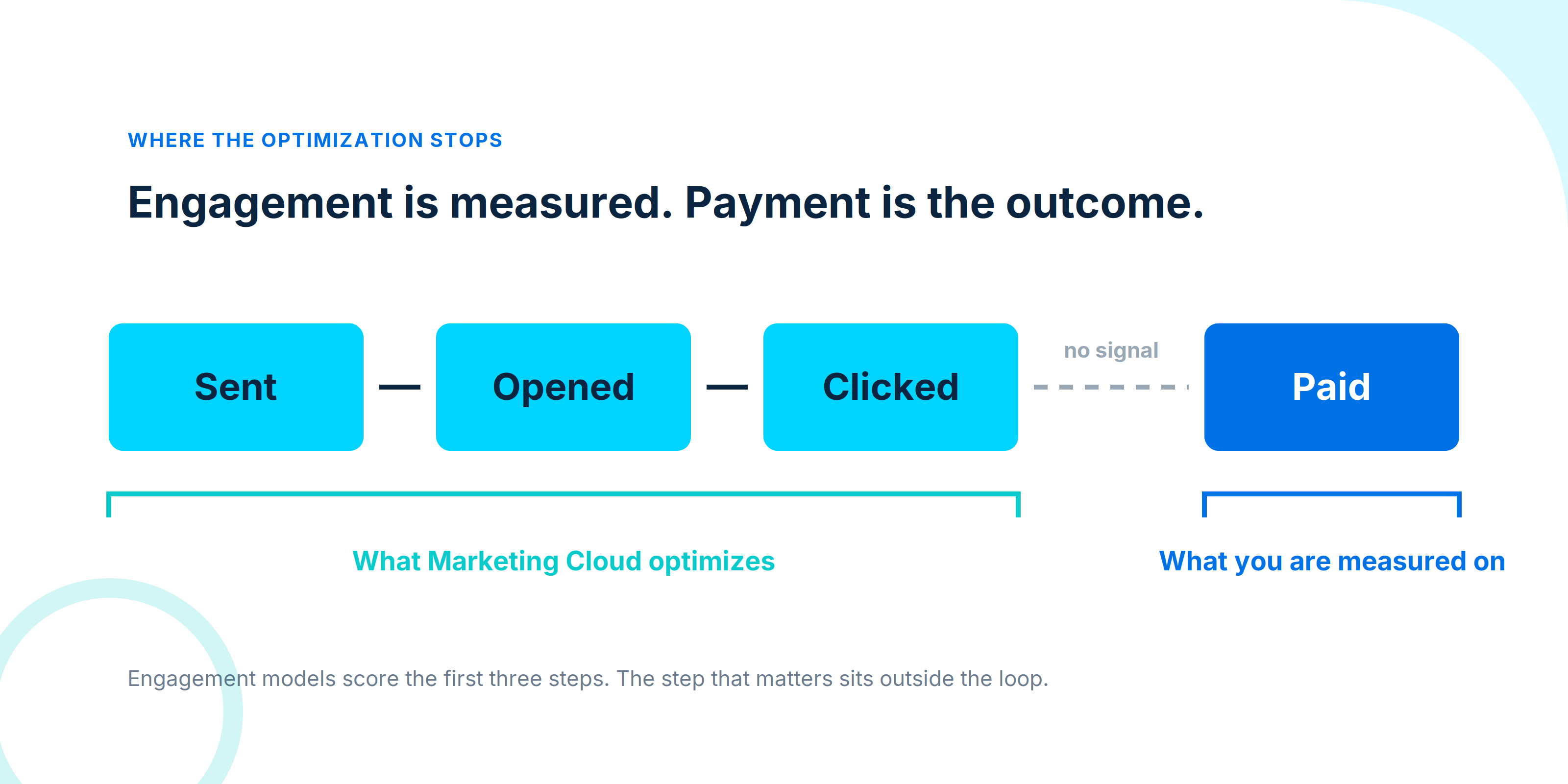
Engagement models score the first three steps. The step that matters sits outside the loop.
2. Blaze can only execute what you already believe
Champion/challenger testing is real capability, and it's often oversold as a substitute for learning. It tests strategies a human already thought to write down. It cannot generate a hypothesis about why a particular customer isn't paying, because that hypothesis isn't in the rule set.
The deeper constraint is what the rules operate on. Blaze segments against attributes of the debt — balance, days past due, risk score, product. Those are facts about an account. They are not facts about a person. Two customers at 45 days past due with identical balances can be in completely different situations: one forgot, one is disputing a charge, one lost income last month and is quietly terrified of the conversation. A risk score cannot tell them apart, so they get the same treatment, and at least two of the three get the wrong one.
Delinquency Archetypes segment on a different axis: capacity to pay against readiness to act, derived from more than 100 behavioral signals. The customer who forgot needs a frictionless reminder. The customer who is financially stressed needs an offer of support before an ask. Same balance, same days past due, different psychology, different outcome.
3. Compliance logic ends up living in two places
Marketing Cloud is architected around permission-based marketing: subscriber lists, opt-in, publication preferences. Collections runs on a different regime — Regulation F, FDCPA, TCPA, PIPEDA — with call frequency caps, restricted contact windows, cease-communication obligations, and edge cases with real teeth. Under the CFPB's debt collection rule, adding content beyond what's required converts a limited-content message into a communication, with all the obligations that follow.
That logic has to live somewhere. In a two-system stack it usually ends up split: eligibility and frequency rules in Blaze, channel and timing branches in Journey Builder decision splits. One regulation, two sources of truth, maintained by two teams on two release cycles. Every audit becomes a reconciliation exercise.
4. The seam is where the learning dies
Decision happens in Blaze. Delivery happens in Marketing Cloud. The outcome — the payment — lands in billing. Every learning loop has to cross at least two system boundaries, and in practice those boundaries are batch — which is where the cost of a fragmented collections stack actually shows up.
That latency is the whole ballgame. Behavioral engagement compounds: you learn something from how a customer responded on Tuesday, and it changes what you send on Thursday. If the outcome data takes a week to make it back to the decisioning layer, you're not running a learning loop. You're running a quarterly review.
Here's the part worth sitting with. Even FICO, which owns both a decisioning engine and a collections communications product, connects them through APIs rather than natively. If the vendor with both layers in-house hasn't fully closed that seam, a customer bolting Blaze to Marketing Cloud with an integration layer isn't going to close it either.
"If the vendor that owns both layers connects them by API, assembling the same two layers yourself won't produce something tighter."
5. Nobody in the stack owns the message
Blaze owns eligibility. Journey Builder owns timing and template selection. Ask either system what tone a message should take, which behavioral tactic it should employ, or whether the framing suits a customer who is avoidant rather than forgetful, and there's no answer — because there's no owner.
So the copy becomes an unmanaged asset. It gets written once, approved by legal, loaded as a template, and left alone for years while everything around it gets optimized. Tone, framing and sequencing are the variables with the largest effect on whether a stressed customer takes action, and they're the only ones in the stack that nobody is testing.
That's the difference between message-level optimization and template selection. SymendCure optimizes at four levels — scoring and segmentation, real-time rescoring on engagement signals, message-level testing, and journey-level iteration — because the message is treated as a variable, not a fixture.
What to do with Blaze and Marketing Cloud instead
Not a rip and replace. That's rarely the right answer and it's never the fast one.
Blaze should keep doing what it's good at: auditable policy execution, portfolio-level decisioning, the credit and risk infrastructure that already works. Marketing Cloud should keep running the channels your marketing organization already lives in. What's missing is the layer between them — the one that decides what to say and why, and learns from whether it worked.
For a telecommunications operator managing millions of past-due accounts, that layer is the difference between sending at scale and recovering at scale. One US wireless carrier runs 2.3 million customer journeys per month through behavioral engagement. A UK credit card provider saw a 60% lift in cure rate alongside an 83% reduction in outbound calls — recovery went up while contact volume went down, which is not a trade-off a frequency-based campaign strategy can produce.
Cure-rate lift and reduction in outbound calls at a UK credit card provider — recovery up, contact volume down.
Integration is deliberately undramatic: data arrives by flat file over SFTP, the same fields already flowing to your existing systems, with most deployments live in four to eight weeks.
The short version
Blaze tells you who to treat. Marketing Cloud tells you when to send. Neither tells you what to say to a person who is behind on a bill and afraid of the conversation — and that's the variable that determines whether they pay.
The gap isn't a missing integration. It's a missing discipline.
See where the behavioral layer fits in your stack
Request a demo and we'll model expected outcomes against your portfolio and current approach — no rip-and-replace required.
REQUEST A DEMO EXPLORE SYMENDCUREKey Takeaways
- A decisioning engine and a delivery platform leave a gap between them: FICO Blaze Advisor decides who to treat and Salesforce Marketing Cloud decides when to send. Neither was built to decide what to say to someone who is behind on a bill and afraid of the conversation.
- What closing that gap looked like for a UK credit card provider: A 60% lift in cure rate alongside an 83% reduction in outbound calls — recovery up while contact volume came down.
- The fix is additive, not a rip-and-replace. Blaze keeps auditable policy execution, Marketing Cloud keeps the channels, and a behavioral engagement layer sits between them to decide the message and learn from whether it worked. Data moves by flat file over SFTP, with most deployments live in four to eight weeks.
- Behavioral science defines the variables, data science defines the methodology, and the platform executes. Proprietary Delinquency Archetypes decode each customer's capacity to pay and readiness to act, delivering empathetic, personalized outreach that resolves accounts and preserves the relationship.
Frequently Asked Questions
No. Most clients run both. Blaze Advisor continues handling credit scoring, adjudication and portfolio-level risk decisions, while the behavioral engagement layer handles segmentation, messaging and orchestration for past-due customers. Data moves by flat file over SFTP, so it sits alongside existing infrastructure with minimal IT lift.
You can encode behavioral rules, but a rules engine can only execute hypotheses someone has already written. It has no mechanism to discover why a customer isn't paying, and it segments on attributes of the debt rather than attributes of the person. Building the behavioral models, the tactic library and the continuous optimization loop yourself is a multi-year program, not a configuration change.
Marketing Cloud optimizes for engagement — opens, clicks, deliverability — and is architected around permission-based marketing and subscriber consent. Collections optimizes for payment and operates under Regulation F, FDCPA, TCPA and PIPEDA. The metrics diverge and the compliance architecture diverges, which means custom logic maintained in parallel with your decisioning engine.
A risk score predicts likelihood of loss. Delinquency Archetypes predict how a customer will respond to engagement, segmenting on capacity to pay against readiness to act using more than 100 behavioral signals. Two customers with identical risk scores can require opposite treatments.
Most deployments are live within four to eight weeks depending on data integration complexity, with AI model training beginning at data ingestion and results improving continuously from there.