
The Hidden Cost of a Duct-Taped Collections Stack
CRM, decisioning, communications, analytics, ML models — five tools held together by integrations and goodwill. The hidden cost isn't infrastructure. It's the recovery rate you're leaving on the table.

Key Takeaways
- Most enterprise collections operations run on a fragmented, multi-vendor stack — CRM, decisioning, comms, analytics, ML, compliance — stitched together by integrations.
- The "integration tax" compounds across five hidden costs: integration fragility, data silos, maintenance overhead, compliance exposure, and lost velocity.
- Reduced velocity is the most expensive and least visible cost — cycle time from insight to live strategy stretches from days to quarters.
- A unified platform inverts the architecture: data, scoring, segmentation, journeys, comms, and analytics share one system and one state, so ML models train on the full picture.
- The enterprise proof is consistent — a North American bank saved $25M+, a US utility is projected to generate up to $30M in annual value, and a wireless carrier runs 16M+ monthly outreaches at 10x ROI.
Map out the collections technology at almost any large enterprise and you'll find the same architectural pattern. A CRM holds the customer records. A decisioning engine — typically a legacy platform — runs the strategy logic. A separate communications platform pushes email and SMS. Voice and IVR live in another system. Analytics sit in a warehouse, fed by ETL jobs that run overnight. ML models live in a data science environment that produces scores on a weekly batch. Compliance reporting comes from a fifth tool, usually run by a different team.
Each one of those tools, individually, is competent. Some are excellent. The problem isn't the components. It's the seams between them. Every integration is a place where data can drift, where latency creeps in, where strategy ideas have to be translated across vendors, where compliance assumptions can quietly fall out of sync. And every seam adds to a cost that doesn't show up on any line item — but eventually shows up in the recovery curve.
This is the duct-taped collections stack. Most enterprises have one. Few have an accurate count of what it's actually costing them.
The five hidden costs of fragmentation
The integration tax on a multi-vendor collections architecture isn't theoretical. It compounds across five distinct cost categories, and once you start tracking them, the size of the problem becomes hard to ignore.
1. Integration fragility
Costly, time-consuming integrations that break under pressure. Every connection between two systems is a piece of code maintained by someone — usually a small team inside your organization or a contracted partner — and every upgrade on either side of the connection is a risk. The integrations rarely break loudly. They break quietly, in the form of a field that stopped syncing six weeks ago, a customer record that's now slightly out of date in three downstream systems, or an ML score that's still being computed on stale data.
2. Data silos
The harder one. A unified customer view is theoretically possible across a fragmented stack — most enterprises have spent significant engineering investment trying to build one. In practice, the data ends up living in the seams: partially in the CRM, partially in the decisioning engine, partially in the warehouse, with each system holding a slightly different version of the truth. Behavioral signals captured by the comms platform don't make it back to the scoring model in time to matter. Engagement data in one system doesn't inform the journey logic in another. The customer experience reflects the architecture — fragmented.
3. Maintenance overhead
Multiple vendor relationships. Multiple software update cycles. Multiple internal expertise requirements. A typical enterprise collections operation has dedicated headcount for managing the vendor stack itself — coordinating contracts, tracking version compatibility, mediating between vendors when something breaks. None of this work moves the recovery curve. It's pure operational overhead, and it scales with the number of tools in the stack.
4. Compliance and risk exposure
The more systems handling customer data, the more surfaces for compliance gaps, data breaches, and inconsistent customer experiences. CFPB requirements, state-level privacy laws, OSFI/OCC guidance, and the rising bar for AI explainability all apply at every touchpoint. A fragmented stack means coordinating consent management, audit trails, and disclosure logic across vendors who may interpret the same regulation differently. The compliance officer's job effectively expands by one for every new tool in the stack.
5. Reduced velocity
The most expensive cost, and the hardest to measure on a budget line. Deploying a new test or strategy requires coordinated changes across multiple systems. A segment update in the decisioning engine has to propagate to the comms platform, which has to align with the analytics warehouse, which has to feed the ML model retraining. Every step adds days. Every dependency adds risk. The cumulative effect is that the cycle time between "we noticed something in the data" and "we have a strategy live in production" stretches from days to quarters.
"The integration tax doesn't show up on a P&L line. It shows up in the recovery curve — slower iteration, staler data, and the strategy ideas that died waiting for the stack to align."
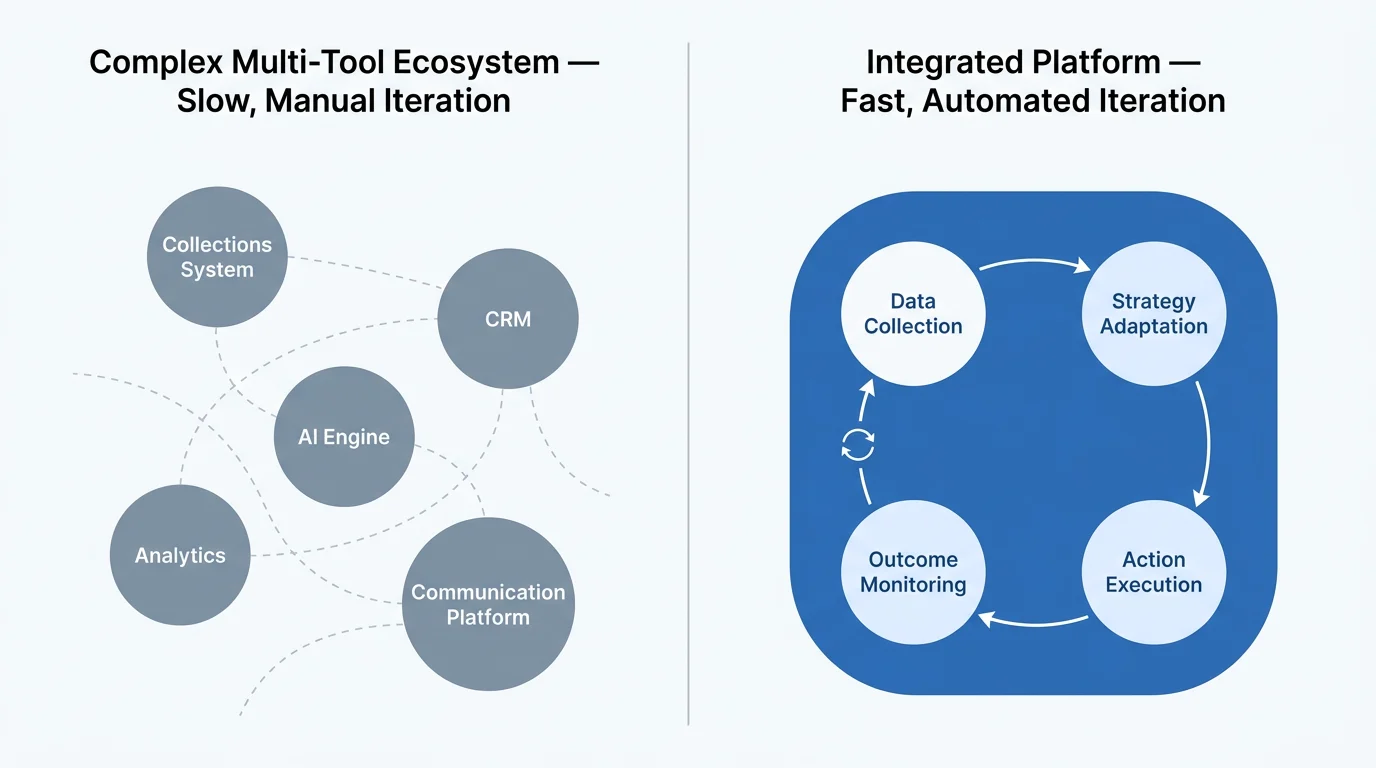
A fragmented stack forces slow, manual iteration across tools. A unified platform runs the full loop — data, strategy, action, outcome — inside one system.
Why this architecture has lasted as long as it has
It's worth being fair to the duct-taped stack. The reason it exists isn't bad judgment by the teams that built it. It's history. Most enterprise collections operations were assembled over a decade or more, one capability at a time. The CRM came in for sales. The decisioning engine came in for risk strategy. The comms platform came in for marketing. The analytics warehouse came in because finance needed reporting. Nobody set out to build a fragmented stack — it accumulated, in response to needs that all looked separate at the time.
And historically, this worked. When billing cycles were monthly, strategic planning was annual, and consumer behavior shifted slowly, a stack that took weeks to coordinate could still keep up with the world. The hidden costs were real but absorbable.
What's changed is the speed of the environment outside the stack. Consumers now receive hundreds of messages a day. Hardship signals are showing up unevenly across geographies and product lines, on cycles that don't match anyone's quarterly planning calendar. AI-driven competitors can iterate on engagement strategy in days. The stack that worked when collections moved on a monthly rhythm isn't the stack that wins when collections needs to move on a weekly one. It's the same dynamic behind why a routine send-window change can take a full quarter to ship.
What an end-to-end platform actually changes
The argument for consolidation isn't that one vendor is better than five. It's that the integration tax — paid in fragility, silos, overhead, compliance exposure, and velocity loss — is no longer worth what it buys. The case for an end-to-end collections platform is that the costs of fragmentation have crossed the threshold where unifying the architecture produces more value than the marginal best-of-breed advantage from any individual component.
In a unified platform, the architecture inverts. Data, scoring, segmentation, journey orchestration, communications, and analytics live in a single system with shared state. The integration tax doesn't disappear entirely — every platform has internal data flows — but it stops being a per-deployment cost paid by your team and becomes a problem the vendor has already solved.
Three operational shifts follow:
- Behavioral signals captured by any channel — email open, SMS reply, voice interaction, payment behavior — feed the scoring model in near real-time, not on a weekly batch.
- Strategy changes propagate across the system in a single configuration step, not across five vendor tickets.
- ML models train and retrain on the full, unified dataset, which is a meaningfully different input than what any individual stack component sees.
The third point matters more than it sounds. Symend's scoring uses over 100 real-time behavioral and engagement indicators, combined with millions of behavioral science data points, to achieve 90%+ predictive accuracy. That accuracy isn't a function of model sophistication alone — it's a function of the model seeing the unified picture. A fragmented stack feeds its ML models a partial view; an integrated platform doesn't. It's the same argument we make for treating behavioral science as the architecture, not an ingredient.
The proof shows up at the enterprise scale
The pattern across Symend's largest deployments is consistent: enterprises that consolidate from fragmented stacks onto a unified platform produce results their previous architecture couldn't generate. A few examples worth flagging.
A major North American bank consolidated collections across more than a dozen product lines onto SymendCure and saved over $25M — including $24M in churn savings and $1.5M in OpEx reductions. Its internal A/B test — with a 10% holdout population — showed a 6% early-stage cure-rate increase and a 23% reduction in early-stage roll rates. That kind of result requires unified treatment across retail credit cards, personal lines of credit, auto loans, student lines, and small business portfolios. It's structurally hard to produce on a stack where each product line is treated by a different combination of tools.
saved by a major North American bank — with a 6% early-stage cure-rate increase, a 23% reduction in early-stage roll rates, and 11x ROI — after consolidating a dozen-plus product lines onto one platform.
One of the largest US utilities, facing $800M in delinquent accounts after pandemic AR ballooned 4x, deployed Symend and is projected to generate up to $30M in annual value, with a 50% reduction in call volume. A fragmented stack can't move at the speed an $800M problem demands. A unified platform can.
A major US wireless carrier runs 16M+ monthly digital outreaches through Symend at a 10x ROI — a volume that would have been operationally impossible to coordinate across separate scoring, segmentation, journey, and comms systems.
"A fragmented stack can absorb costs at small scale. At enterprise scale, those costs compound into the recovery rate, the OpEx ratio, and the difference between catching a trend and chasing one."
The common thread isn't a feature. It's the architecture that made the outcome possible. None of these results are reachable on a stack where every cross-system change has to be coordinated by hand.
How to evaluate this without taking a vendor's word for it
Consolidation is a serious commitment, and the case for it has to be made on evidence, not slogans. Four questions tend to surface the truth quickly:
- Map your current stack. List every system involved in collections — CRM, decisioning, comms, voice, analytics, ML, compliance. Count the integrations. Count the vendors. The number is usually larger than leadership thinks.
- Measure cycle time honestly. From the moment a strategist identifies a change to the moment it's live in production, what's the average and the 90th percentile? If the answer is in weeks, the stack is the bottleneck.
- Quantify the integration headcount. How many people on your team — and how much of your IT budget — exist primarily to keep the stack stitched together? This is the most overlooked cost in collections technology.
- Pressure-test the vendor's velocity claims. Any vendor pitching consolidation should be able to point to a recent client deployment that moved from kickoff to live pilot in weeks, with documented before-and-after metrics. If they can't, the platform's architecture probably isn't as integrated as the pitch deck suggests.
The right consolidation decision isn't always immediate replacement. For some enterprises, the path is consolidating the highest-friction parts of the stack first — usually scoring, segmentation, journey orchestration, and comms — and leaving the periphery for later. The point is to make the integration tax visible enough that the math gets honest.
The bottom line
The duct-taped collections stack isn't a technology problem; it's an architectural one. Each tool in it may be competent. The cost is in what happens between them — in the silos, the latency, the integration brittleness, the compliance exposure, and most importantly, the velocity loss that determines whether your team is operating on this quarter's reality or last quarter's. In a market where consumer behavior is shifting faster than legacy stacks can coordinate, the gap between fragmented and unified architectures is no longer a theoretical advantage. It's a quantifiable one, and it shows up in the recovery rate.
For a deeper read on how a unified, behavioral-science-driven platform actually works end-to-end, see how SymendCure orchestrates scoring, segmentation, journeys, and analytics in a single system, or explore how the Symend platform works. For industry-specific applications, the financial services, telecommunications, and utilities pages walk through deployment patterns and outcomes by vertical. The full case study library is the cleanest place to see what consolidation produces in practice.
See what a unified collections platform can do for your portfolio
Replace the integration tax with one system for scoring, segmentation, journeys, and comms. Book a 15-minute demo to see how consolidation shows up in the recovery curve.
EXPLORE SYMENDCURE REQUEST A DEMOFrequently Asked Questions
A fragmented stack is a collection of separate tools — CRM, decisioning engine, communications platform, analytics warehouse, ML environment — connected by integrations. A unified platform handles all of those functions inside a single system, with shared data and shared state. The difference shows up in cycle time, data freshness, and the system's ability to learn from every customer interaction across every channel.
Historically, yes. The argument for best-of-breed assumed that the marginal capability advantage of each component outweighed the integration cost between them. That math has shifted. The integration tax — paid in fragility, data silos, maintenance overhead, compliance exposure, and slowed iteration — has grown faster than the best-of-breed advantage. In collections specifically, where speed of iteration directly determines recovery performance, unified architectures now produce outcomes fragmented ones can't match.
Symend deployments typically move from kickoff to live pilot in weeks, not months, using a structured 90-day pilot framework that produces measurable performance benchmarks before scale-up. White-glove implementation handles data ingestion, brand templates, campaign configuration, and testing — keeping the client team's lift low. Full enterprise rollouts across multiple product lines typically take longer, but the value generation starts in the first pilot.
Across documented Symend deployments, clients have seen 10x ROI, roughly 10% improvements in recovery rates, and approximately 50% reductions in OpEx. Specific case studies show larger results — a major North American bank realized $25M+ in combined savings, a US utility is projected to generate up to $30M in annual value, and a UK credit card provider produced a 60% cure-rate lift while collecting £40M. Outcomes vary by portfolio composition and starting baseline, but the directional pattern is consistent.
In a fragmented stack, compliance logic — consent management, audit trails, disclosure handling, do-not-contact rules — has to be implemented and maintained separately in each tool, with no single source of truth. In a unified platform, compliance rules apply once and propagate across every channel and every touchpoint. The difference matters most in environments with strict regulatory oversight (CFPB in financial services, state-level privacy laws, OSFI guidance in Canada), where inconsistency across systems is the most common failure mode.