
How Two-Way AI Conversations Are Replacing One-Way Collection Notices
One-way notices trigger the exact resistance they're meant to overcome. Here's the behavioral science behind two-way AI conversations — and what the evidence actually shows.

Key Takeaways
- Debt collection complaints to the CFPB rose 89% in a single year to 207,800 — a signal that unsolicited one-way contact is generating resistance faster than resolution.
- One-way demands trigger psychological reactance. McKinsey found 20% of consumers withheld a payment they had already planned to make after an upsetting collector call.
- A 2025 NBER field experiment found AI callers underperformed humans at securing binding promises — a real result, driven by weaker social obligation to a machine and a fixed negotiation script, not proof that dialogue itself fails.
- Digital channels achieve a 73% payment rate in late delinquency, yet 66% of collections contacts still run through traditional broadcast channels.
- SymendConverse applies Delinquency Archetypes to the voice channel — the voice expression of the same behavioral model behind SymendCure's digital journeys — so each conversation is calibrated to that customer's capacity to pay and readiness to act.
The complaint data says the model isn't working
American consumers filed 207,800 debt collection complaints with the Consumer Financial Protection Bureau in 2024 — an 89% increase in a single year, according to the CFPB's annual FDCPA report. The largest complaint category wasn't harassment or fees. It was people saying the debt wasn't theirs.
That's usually read as a compliance story. It's more useful as a product design story. Numbers like these tell you that the dominant model of past-due contact — unsolicited, one-directional, and near-identical for every customer — is producing confusion and resistance faster than it produces payment. The industry has spent a decade making that model cheaper and faster to run. Volume was never the problem. Direction was.
A one-way notice makes the customer a passive recipient of a demand. A two-way conversation makes them a participant in a resolution. What follows is the behavioral science behind why that distinction changes outcomes, the strongest piece of evidence against AI in collections and why it doesn't say what most people think it says, and what the results look like when dialogue replaces broadcast.
Why one-way messages trigger the wrong response
Psychological reactance is the term for what happens when someone receives a demand they didn't ask for: the instinct to reassert control, often by refusing to do the thing being demanded — even when complying would be easy.
In collections, that instinct is expensive. McKinsey research found that 20% of consumers withheld a planned payment at least once after receiving an upsetting call from a collector. The money was there. The intent was there. The call is what stopped it.
of consumers withheld a payment they had already planned to make after an upsetting call from a collector. Source: McKinsey
Financial stress compounds the effect. Research published in Science by Mani and colleagues found that the cognitive load of managing pressing financial obligations consumes enough mental bandwidth to be equivalent to a 13-point drop in effective IQ. As we've written about how scarcity inhibits decision-making, a past-due customer isn't your average customer who happens to owe money. They are operating with measurably less capacity to parse a complex demand, weigh options, and act.
Into that narrowed attention, a letter, a blast SMS, or an outbound robocall lands as one more obligation with no visible path through it. A conversation lands as a possible way out. Same customer, same balance, opposite psychological experience.
"But didn't a study find AI performs worse than humans?"
It's the most common objection, and it deserves a direct answer rather than a deflection.
In April 2025, an NBER working paper by Choi, Huang, Yang and Zhang reported results from a field experiment — run with a large lender in China — comparing AI voice callers with human callers in debt collection. The AI wasn't a recording: it understood what borrowers said, classified their responses, and negotiated within set parameters. It still produced 21% fewer promises to repay and roughly one-third fewer payments within two hours of contact, and borrowers first reached by AI were still repaying slightly less a year later. The researchers attributed the gap to AI's lesser ability to extract promises that feel binding — people don't experience the same social obligation toward a commitment made to a machine.
That finding is real, and collections leaders should take it seriously rather than explain it away. It's genuine evidence that swapping a human voice for a machine on the same negotiation script costs you binding commitments. But the mechanism the researchers identified — weaker social obligation to a machine — is a design problem, not a verdict on dialogue itself. The AI in the study negotiated, but it did so from a fixed script, with no model of who each borrower was or what would actually move them.
That's the gap behavioral science is built to close. When the system knows a customer's capacity to pay and readiness to act before the call, presents genuine options instead of pressing for a single outcome, and hands off to a human at the moments that need one, the customer isn't having a promise extracted from them — they're making a choice. Restoring that sense of agency is precisely what a one-way demand destroys. The lesson from the study isn't "AI can't collect." It's that AI without behavioral calibration inherits the same weakness as the script it's reading.
"The lesson isn't that AI can't collect — it's that AI without behavioral calibration inherits the weakness of the script it reads."
What changes when dialogue replaces broadcast
The gap between what performs and what's deployed is unusually wide here. McKinsey reports that digital channels achieve a 73% payment rate in late-stage delinquency, while 66% of collections contacts still run through traditional broadcast channels. Most of the industry is still spending most of its contact budget on the lower-performing option.
payment rate for digital channels in late-stage delinquency — versus the broadcast channels that still carry 66% of collections contacts. Source: McKinsey
The reason is the one the behavioral research predicts. A channel that lets a customer respond, weigh real options, and set the terms of their own repayment restores the sense of control that a one-way demand strips away — and people act more readily on a plan they chose than on a demand they were handed. That's the shift the strongest telecommunications and utility collections operations are making deliberately: not automating the old notices faster, but changing who holds the initiative.
The industry has noticed. TransUnion's 7th Annual Debt Collection Industry Report found that virtual negotiator and AI self-service adoption climbed 35 percentage points in a single year, reaching 64% of the industry by 2025 — and 72% of collections companies said their AI and machine learning investments met or exceeded expectations.
Adoption curves that steep usually mean something is working. What's working isn't "AI in collections" as a category. It's the specific shift from telling customers what to do to asking them what they can do.
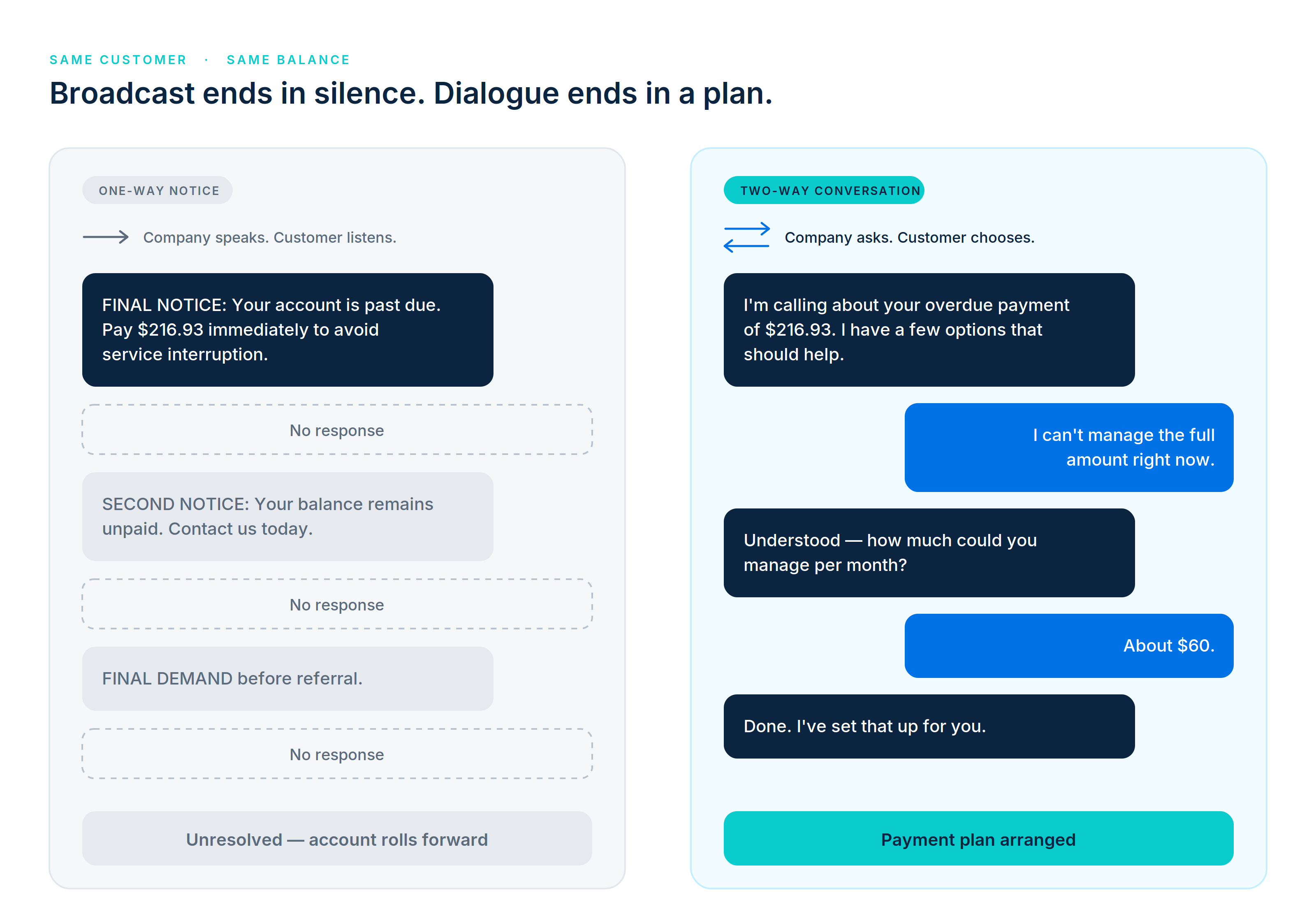
Same customer, same balance. The difference is who gets to speak.
What separates a conversation from a broadcast in disguise
Not every system marketed as conversational AI actually conducts a conversation. Four things distinguish the ones that do.
- It listens and adapts. The system adjusts based on what the customer actually says, not what the script predicted they'd say. Intent recognition and real-time negotiation are the difference between a dialogue and a decision tree.
- It presents options, not demands. Choice restores perceived autonomy, which is precisely what reactance takes away. A customer who selects a payment plan is meaningfully more likely to follow through than one who was told what to pay.
- It reaches the customer at the right moment. Behavioral science doesn't only govern what you say — it governs when, through which channel, and to whom. The same message delivered on the wrong day to the wrong customer produces resistance instead of resolution. Our breakdown of seven behavioral science tactics that determine whether a customer pays covers the specific levers.
- It's built for compliance, not retrofitted onto it. Every conversation is logged. Frequency caps are enforced in code rather than in policy documents. The Mini-Miranda disclosure is part of the opening, and opt-out is available in every channel, every time.
Those four criteria are also a useful screen when you're evaluating a collections vendor. A demo that only shows the happy path is showing you a script.
Where SymendConverse fits
SymendConverse applies these principles to the voice channel — still the highest-cost, highest-friction part of most collections operations. It isn't a chatbot bolted onto a collections workflow. It's conversational agentic AI purpose-built for delinquency, running on the same Delinquency Archetypes that drive SymendCure's digital engagement journeys — so every conversation is calibrated to that customer's capacity to pay and readiness to act before it begins. Voice and digital share one behavioral model; SymendConverse is its voice expression.
That means a high-capacity, high-readiness customer hears a short path to closing out the balance today, while a customer facing genuine hardship is walked through the options available to them, in a tone matched to the situation. The conversation responds to what the customer says rather than routing them down a fixed flow, and outcomes feed back into the same behavioral model that informs SymendCure's email and SMS journeys.
Behavior doesn't change between channels. The right message is the right message whether it arrives as a text, an email, or a call — and the conversation should adapt to the person on the other end either way.
The direction is the strategy
The collections industry built its infrastructure on a broadcast assumption: send enough notices and the right customers will pay. The complaint data, the behavioral research, and the outcome data all point the same direction — the customers who can pay are often the ones a one-way demand pushes away.
Replacing broadcast with dialogue isn't a channel upgrade. It's a change in who holds the initiative in the conversation, and that turns out to be what moves the numbers.
Turn collection notices into conversations
See how SymendConverse applies behavioral science to the voice channel — calibrated to each customer's capacity to pay and readiness to act.
EXPLORE SYMENDCONVERSE REQUEST A DEMOKey Takeaways
- One-way notices trigger the resistance they are meant to overcome: Psychological reactance is the instinct to reassert control by refusing a demand. McKinsey found 20% of consumers withheld a payment they had already planned to make after an upsetting collector call.
- The strongest evidence against AI in collections tested the wrong thing: The 2025 NBER study reporting 21% fewer promises to repay tested AI reading outbound scripts — broadcast with a synthetic voice. It is evidence against script automation, not against dialogue.
- Dialogue outperforms broadcast, but broadcast still gets the budget: Digital channels achieve a 73% payment rate in late-stage delinquency, yet 66% of collections contacts still run through traditional broadcast channels.
- Behavioral science defines the variables, data science defines the methodology, and the platform executes. Proprietary Delinquency Archetypes decode each customer's capacity to pay and readiness to act, delivering empathetic, personalized outreach that resolves accounts and preserves the relationship.
Frequently Asked Questions
Conversational AI in debt collection is technology that conducts two-way dialogue with customers — responding to what they say, adapting in real time, and offering options rather than broadcasting demands. Effective conversational AI is built on behavioral science models that identify each customer's communication preferences, capacity to pay, and readiness to act before the conversation begins.
One-way notices — letters, outbound calls, blast SMS — trigger a psychological response called reactance: the instinct to resist demands from external sources. McKinsey found that 20% of consumers withheld a planned payment after an upsetting collector call. The payment was already coming; the call stopped it. Financial stress compounds the problem by reducing cognitive bandwidth, making impersonal demands feel overwhelming rather than actionable.
A 2025 NBER working paper found that AI voice callers produced 21% fewer promises to repay than human callers, because people feel less social obligation to commitments made to a machine. The study's AI was adaptive — it understood speech and negotiated — but it worked from a fixed script with no model of the individual borrower, and it was a single field experiment conducted in China. The takeaway isn't that AI can't hold a collections conversation; it's that AI without behavioral calibration — matching options, tone, and timing to each customer's capacity to pay and readiness to act — inherits the weakness of the script it reads.
The FDCPA and Regulation F apply to AI communications the same way they apply to human communications. Requirements include the Mini-Miranda disclosure at the start of every communication, a validation notice within five days of initial contact, frequency caps of seven calls per seven-day period per debt, and a clear opt-out path in every electronic channel. A growing number of state-level rules additionally require disclosing that the customer is interacting with AI, and those requirements are tightening through 2025–2026.
SymendConverse is built on Symend's Delinquency Archetype framework, which segments customers by capacity to pay and readiness to act before any conversation begins. Rather than routing all customers through the same dialogue flow, SymendConverse calibrates the conversation — channel, timing, framing, options presented — to what behavioral science indicates each customer is most likely to respond to. It is outbound-led, logs every interaction for compliance, and integrates with existing CRM and collections workflows.