
Delinquency Is a Lagging Indicator
The behaviour that predicts default shows up one to two years before the missed payment

Why is delinquency a lagging indicator?
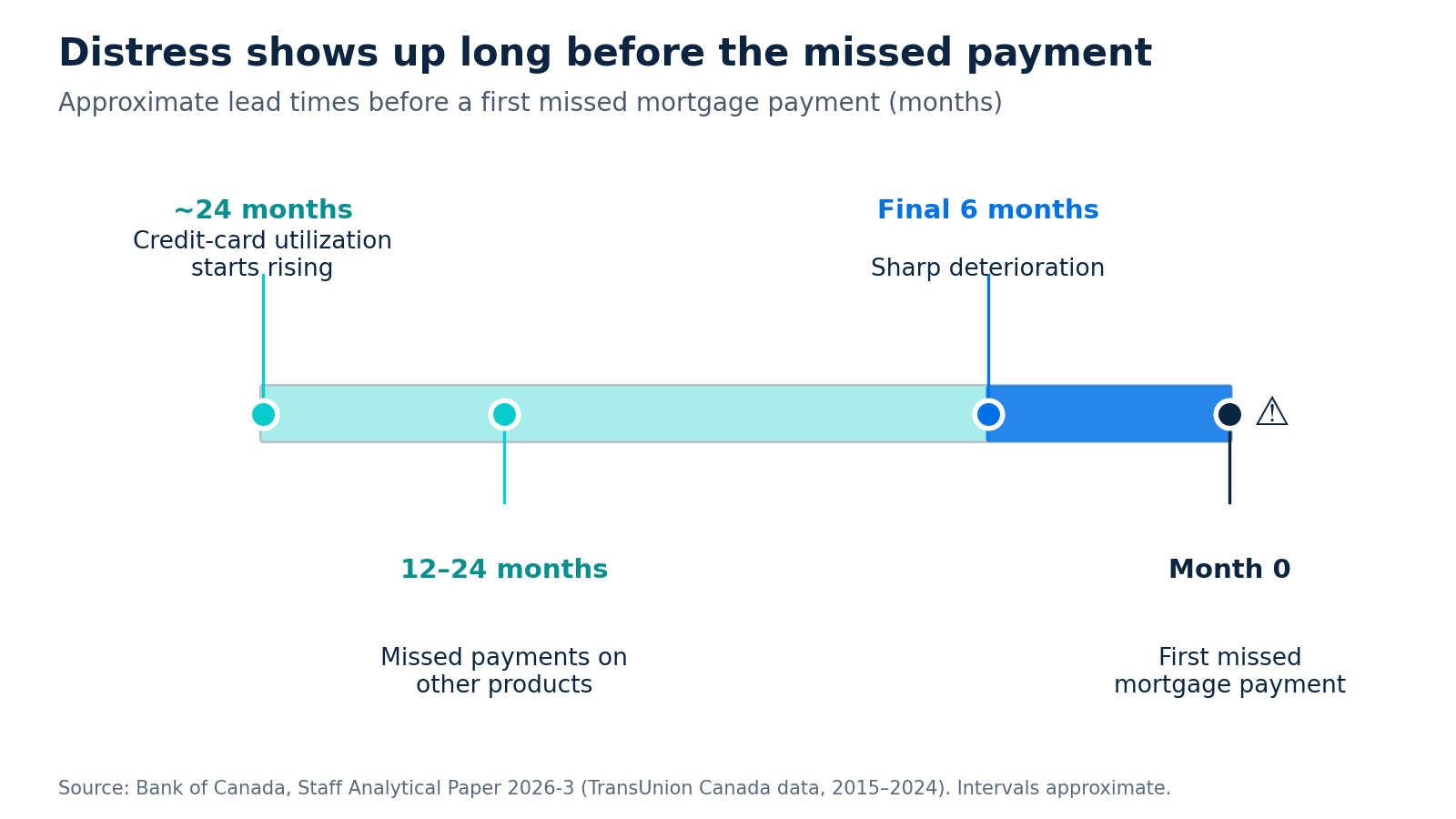
Delinquency is a lagging indicator because the financial distress behind it starts one to two years earlier. Research on Canadian credit files shows card utilization rising about two years before a first missed mortgage payment, missed payments on other products one to two years out, and sharp deterioration in the final six months.¹
By the time a customer appears in a 30-days-past-due queue, the event that put them there is old news. Delinquency is where financial distress ends up, long after it starts.
What are the early warning signs of delinquency?
The leading indicators are behavioural, and they are visible to any issuer willing to look. A record 10.84% of active credit-card accounts at large US banks were making only the minimum payment at the end of 2025, the highest share in the series’ history, before easing to 10.24% in early 2026.²
of active credit-card accounts at large US banks were paying only the minimum at the end of 2025, a series record.
Source: Federal Reserve Bank of Philadelphia, via FRED
The Consumer Financial Protection Bureau (CFPB) found that card utilization rises before consumers adopt buy-now-pay-later (BNPL) financing, which makes BNPL adoption a trailing marker of tightening cash flow. And 63% of BNPL borrowers hold multiple BNPL loans at once, many of which don’t appear in mainstream credit files.³
When stress finally surfaces, it surfaces everywhere at once. Among student-loan borrowers who defaulted in early 2026, 56% were also past due on a credit card and 40% on an auto loan.⁴
Behaviour changes before the score does
Notice what these signals have in common. Utilization creep, minimum-payment persistence, payment-hierarchy shifts and BNPL stacking are all changes in behaviour, not changes in score, and all come before the delinquency event by months or years.
“An issuer whose intervention model triggers at 30 days past due has chosen to act on the oldest possible information.”
Disengagement is visible before the missed payment
There is a further signal layer that public research has not yet quantified: how customers engage before they miss a payment. Do they open statements, visit portals, respond to outreach, or go quiet? Practitioner experience says disengagement precedes default, but no Federal Reserve or bureau study yet puts a number on it.
Symend’s own program data does. Across 1.79 million pre-delinquency messages sent for a major North American bank between January 2024 and October 2026, accounts that went on to roll into delinquency opened at 45%, against 50% for accounts that stayed current. Delivery rates were materially equal across both groups, so the gap is behavioural, not a deliverability artefact.
What this means for issuers
The data to see distress coming already sits inside the servicing stack. What most institutions lack is the instrumentation to read it and the operating model to act on it before the roll begins. For banks and card issuers facing today’s credit card delinquency picture, that means reading behaviour continuously, which is the job SymendCure’s behavioural segmentation is built to do.
The bottom line
Delinquency tells you who has already fallen behind. Behaviour tells you who is about to. The full paper, “The Averages Are Lying,” carries the complete argument: who is actually under stress, why credit scores miss it, and the playbook for acting on behaviour before the roll begins.
A 7-part series
The New Delinquency Playbook
Seven short posts drawn from two Symend research papers. The first, “The Averages Are Lying,” argues that consumer stress has become concentrated rather than widespread, that delinquency is a lagging indicator, and that credit scores have decoupled from behaviour, so issuers need to read behaviour early, re-segment on it, and move intervention upstream. The second, “AI Is an Engine,” argues that collections AI amplifies whatever operating philosophy it is given, so it only works when behavioural science steers it, outcome objectives replace deflection metrics, and credit decisions stay on the deterministic side of the line.
From “The Averages Are Lying”
- Part 2 of 7 The K-Shaped Consumer Why every aggregate dashboard is wrong about consumer stress
- Part 3 of 7 Same Score, Different Customer Credit scores have decoupled from behaviour — and treatment built on them shows it
- Part 4 of 7 The Prevention Curve The economics of acting before the roll
From “AI Is an Engine”
- Part 5 of 7 The 95% Problem Collections is adopting AI faster than it is getting results
- Part 6 of 7 The Stigma Exception Most consumers dislike service AI. Debt may be different — if the engine is steered right
- Part 7 of 7 The Deterministic Line What AI must never decide in collections — and where it earns its keep
Frequently asked questions
What are the early warning signs of delinquency?
Rising card utilization, persistent minimum payments, missed payments on other products, BNPL stacking and declining engagement with statements and outreach. Research shows some of these appear one to two years before a first missed payment.
Why is delinquency considered a lagging indicator?
It records the end of a process that starts much earlier. By the time an account is 30 days past due, the cash-flow strain behind it has usually been building for months or years.
Can credit scores predict delinquency early?
Scores tend to move after behaviour does. Utilization creep and payment-hierarchy shifts are behavioural changes that usually show up before a score reflects the risk.
What is pre-delinquency engagement?
Outreach to customers who are still current but showing signs of strain, so an issuer can offer a reminder or a better payment structure before a payment is missed.
How can banks act on early warning signals?
Instrument the data already in the servicing stack, segment customers by behavioural response rather than score band, and move intervention upstream of the first missed payment.
Endnotes
- Bank of Canada, Staff Analytical Paper 2026-3, February 2026. TransUnion Canada credit data, 2015–2024. Canadian mortgage data; we treat the lead-time pattern, not the exact intervals, as the transferable finding.
- Federal Reserve Bank of Philadelphia, large-bank credit-card data via FRED (RCCCBSHRMIN): 10.84% in Q4 2025; 10.24% in Q1 2026.
- Consumer Financial Protection Bureau, BNPL borrower report, January 2025 (2021–2022 data).
- Federal Reserve Bank of New York, Liberty Street Economics, “Federal Student Loan Defaults Return After Pandemic Pause,” May 2026. Simultaneity measured at default, not lead time. Student-loan serious delinquency subsequently fell from 12.88% to 7.83% year over year (Q2 2026), partly mechanically as defaults left the delinquent stock.


