
The Deterministic Line
What AI must never decide in collections — and where it earns its keep

What should AI never decide in collections?
AI should not decide who gets credit, forbearance or a settlement. Those decisions should stay deterministic: explainable machine-learning models with audit trails. Large language models can handle conversation, data analysis and configuration inside tested guardrails, but their outputs vary, and creditors must give specific, accurate reasons for adverse action.²
Where the line sits
The architecture question is where enthusiasm most needs discipline. Our position, stated plainly: credit rules and credit decisions must remain deterministic, run on explainable machine-learning models with audit trails. Automated communication, in voice or text, can use LLMs, provided it is heavily tested inside guardrails. LLMs are also strong accelerants for data analysis and platform configuration. What they must not do, yet, is decide who gets credit, forbearance or a settlement.
LLM hallucination rates set the line
The reliability evidence sets the line. Stanford’s peer-reviewed audit of purpose-built, retrieval-grounded legal AI tools, systems engineered for accuracy in a regulated domain, found they still hallucinated 17% to 33% of the time. General-purpose LLMs erred on 58% to 82% of legal queries.¹
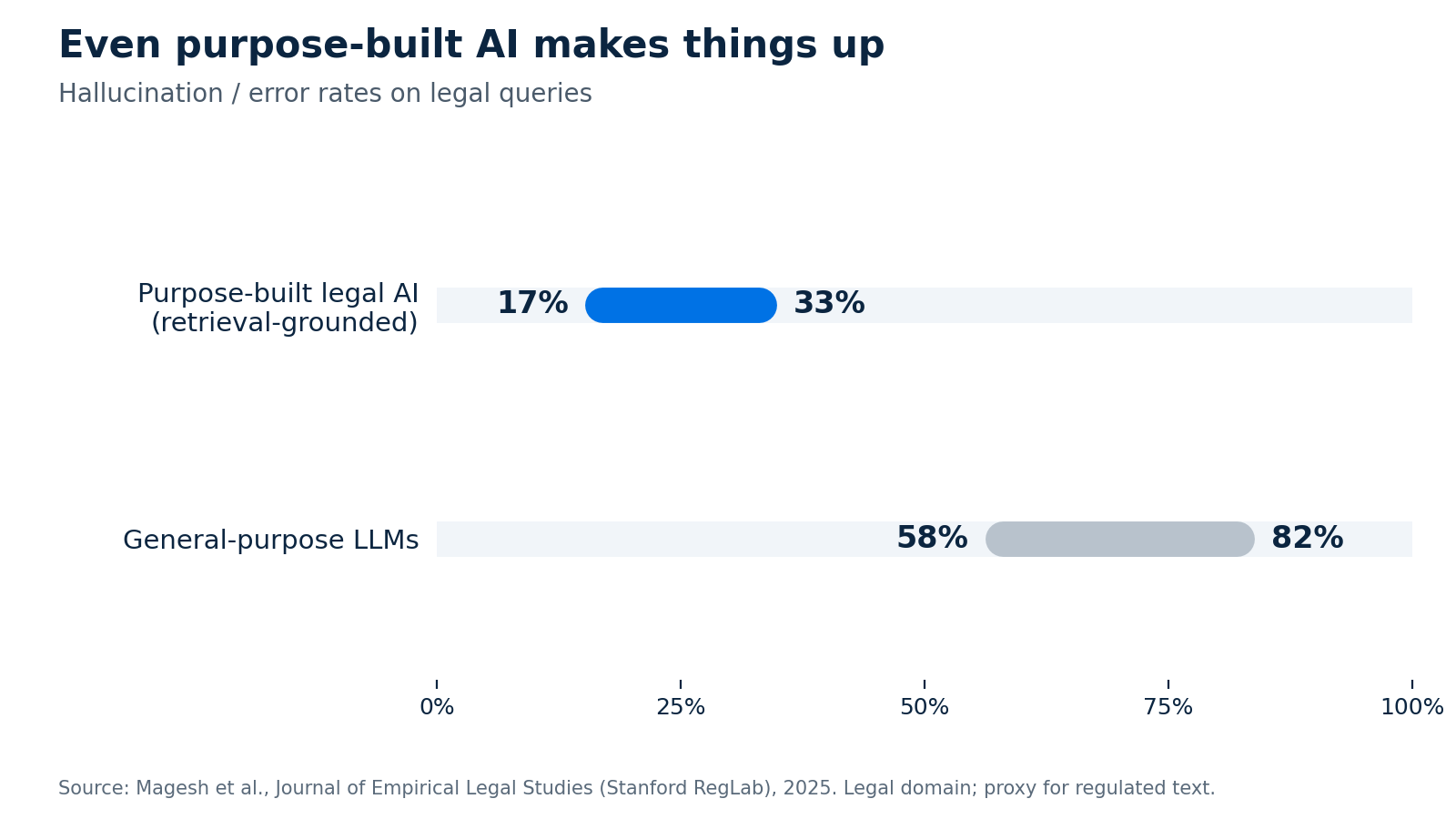
Sources: Magesh et al., Journal of Empirical Legal Studies, 2025 (purpose-built legal AI); Dahl et al., Journal of Legal Analysis, 2024, as reported in Magesh et al. (general-purpose LLMs).
Language models are stochastic instruments. In conversation, inside tested bounds, that flexibility is the feature: understanding a customer’s actual words, negotiating within pre-approved limits, warmth at scale. In a credit decision, it is a liability no institution should accept, and one the law does not accommodate. The Equal Credit Opportunity Act and Regulation B require creditors to give specific, accurate reasons for adverse action, whatever the sophistication of the model.²
“A decision that cannot be explained cannot be lawfully defended.”
Regulation has loosened. The statutes haven’t.
Note carefully what regulation is and is not doing here, because the ground moved in the past eighteen months. The US window is deregulatory. The CFPB withdrew its AI adverse-action circulars in May 2025; the banking agencies rescinded the fifteen-year-old model-risk guidance SR 11-7 in April 2026 and explicitly carved generative and agentic AI out of its replacement; enforcement of Colorado’s AI act was stayed before it ever took effect; and Europe deferred its high-risk credit obligations to late 2027.³
No AI-specific rule currently forces discipline on a collections program. The durable constraints are the old statutes, meaning fair-lending, debt-collection and telephone-consent law, and the state attorneys general and plaintiffs’ bar that enforce them.
“The AI-specific discipline, in other words, is now a choice.”
The institutions that make that choice are building compliance support into architecture, with deterministic rails around stochastic capability, because that is sound engineering under statutes that never expire. No platform makes a program compliant on its own, but the right architecture makes a compliance program far easier to support and defend.
Deterministic vs. generative AI: the division of labour
The practical division of labour looks like this:
| Deterministic systems own | Stochastic (LLM) systems own |
|---|---|
| Eligibility | Reading a customer’s situation from her own words |
| Treatment boundaries and payment terms | Choosing phrasing and tone |
| Disclosure content | Conducting the conversation |
| Every action that moves money or creates a legal record | Always inside the sandbox the deterministic layer defines, and tested against thousands of adversarial cases before a customer hears it |
The AI research community has reached the same conclusion from the engineering side: state-of-the-art reliability comes from compound systems that wrap models in retrieval, verification and deterministic control logic, never from a monolithic model handed the keys.⁴ Symend’s own platform follows this split: behavioural segmentation runs on supervised machine-learning models, while SymendConverse handles the conversation layer.
What this means for issuers
Ask any AI vendor two questions. Where, exactly, is the deterministic line in your architecture? And how many adversarial test cases did this conversation flow survive before production? For banks and lenders, where adverse-action rules apply, the first question is not optional.
“Vendors who answer with model names have answered both questions.”
The bottom line
Let AI talk; don’t let it decide. The full paper, “AI Is an Engine,” carries the complete argument: the adoption-results gap, the broken-playbook failure mode, and why rising data barriers reward compliance built into architecture.
A 7-part series
The New Delinquency Playbook
Seven short posts drawn from two Symend research papers. The first, “The Averages Are Lying,” argues that consumer stress has become concentrated rather than widespread, that delinquency is a lagging indicator, and that credit scores have decoupled from behaviour, so issuers need to read behaviour early, re-segment on it, and move intervention upstream. The second, “AI Is an Engine,” argues that collections AI amplifies whatever operating philosophy it is given, so it only works when behavioural science steers it, outcome objectives replace deflection metrics, and credit decisions stay on the deterministic side of the line.
From “The Averages Are Lying”
- Part 1 of 7 Delinquency Is a Lagging Indicator The behaviour that predicts default shows up one to two years before the missed payment
- Part 2 of 7 The K-Shaped Consumer Why every aggregate dashboard is wrong about consumer stress
- Part 3 of 7 Same Score, Different Customer Credit scores have decoupled from behaviour — and treatment built on them shows it
- Part 4 of 7 The Prevention Curve The economics of acting before the roll
From “AI Is an Engine”
- Part 5 of 7 The 95% Problem Collections is adopting AI faster than it is getting results
- Part 6 of 7 The Stigma Exception Most consumers dislike service AI. Debt may be different — if the engine is steered right
Frequently asked questions
What is explainable AI in collections?
Models whose decisions can be traced and explained, with audit trails showing why a customer received a given treatment or outcome. They are the right tool for anything that decides eligibility, terms or money movement.
Can large language models make credit decisions?
They shouldn’t. Creditors must give specific, accurate reasons for adverse action under the Equal Credit Opportunity Act and Regulation B, and LLM outputs are variable and hard to explain. This is not legal advice; consult your compliance team.
How often do LLMs hallucinate?
In Stanford’s audit, purpose-built legal AI tools hallucinated 17% to 33% of the time, and general-purpose LLMs erred on 58% to 82% of legal queries.
What changed in AI regulation for lenders in 2025–2026?
The CFPB withdrew its AI adverse-action circulars in May 2025, US banking agencies replaced model-risk guidance SR 11-7 in April 2026 (excluding generative AI), Colorado’s AI act was stayed, and the EU deferred high-risk credit obligations to December 2027. Status as of August 31, 2026.
What should you ask an AI collections vendor?
Where the deterministic line sits in their architecture, and how many adversarial test cases each conversation flow passed before going live.
Endnotes
- Magesh, Surani, Dahl, Suzgun, Manning & Ho, Journal of Empirical Legal Studies (Stanford RegLab), 2025. Legal domain; best available proxy for LLM reliability on regulated text. The 58–82% figure for general-purpose LLMs is reported there from earlier Stanford work: Dahl, Magesh, Suzgun & Ho, “Large Legal Fictions: Profiling Legal Hallucinations in Large Language Models,” Journal of Legal Analysis, 2024.
- Equal Credit Opportunity Act; Regulation B, 12 CFR 1002.9. The CFPB’s interpretive circulars on AI adverse action (2022-03, 2023-03) were withdrawn May 2025; the statutory and regulatory requirements stand.
- CFPB withdrawn-guidance list and Federal Register, May 2025; OCC/Federal Reserve/FDIC, Revised Guidance on Model Risk Management, April 17, 2026 (generative and agentic AI excluded from scope); Colorado SB 24-205 enforcement stayed April 2026; a narrower replacement (SB 26-189, ADMT transparency framework) signed 2026-05-14, effective 2027-01-01; EU Digital Omnibus (Regulation (EU) 2026/1744, in force July 2026) deferring Annex III high-risk obligations (including credit scoring) to 2027-12-02. Status as of 2026-08-31. Regulation F (12 CFR Part 1006) remains in effect and unchanged.
- Zaharia et al., “The Shift from Models to Compound AI Systems,” Berkeley Artificial Intelligence Research, February 2024.


