
The 95% Problem
Collections is adopting AI faster than it is getting results

Why do most collections AI projects fail to deliver results?
Most stall because they are pointed at the wrong problem. Nearly all collections companies are using or planning to use AI, yet only a small share of companies see material earnings impact from AI. Tools that raise individual productivity without changing outcomes are often automating a playbook built on the wrong assumptions.
AI in collections: the adoption numbers
The adoption numbers describe a stampede. Worldwide AI spending is forecast to reach $2.6 trillion in 2026, up 47% in a year.¹ In collections specifically, TransUnion’s industry survey found 93% of companies using or planning AI and machine learning, up from 49% in 2023, with voice communication at 44% and negotiation support at 42%. And 98% of firms now offer at least one self-service channel.² Every top-ten US bank ran a customer-facing chatbot at the CFPB’s last count.³
of collections companies are using or planning to use AI and machine learning, up from 49% in 2023.
Source: TransUnion, Debt Collection Industry Report, 2026
The results numbers
The outcome numbers describe something else. MIT researchers reported in 2025 that 95% of enterprise generative-AI pilots produced no measurable profit-and-loss impact. The methodology has been fairly contested, but the direction matches independent data.⁴ S&P Global found the share of companies abandoning most of their AI initiatives leapt from 17% to 42% in a single year.⁵
Gartner predicts more than 40% of agentic-AI projects will be cancelled by the end of 2027,⁶ and its research on the current generation of self-service tools found only 14% of customer-service issues are fully resolved in self-service.⁷ McKinsey’s 2026 global survey completes the picture: 89% of organizations use AI and 80% of people report personal productivity gains, yet only 6% of companies are high performers achieving material earnings impact.⁸
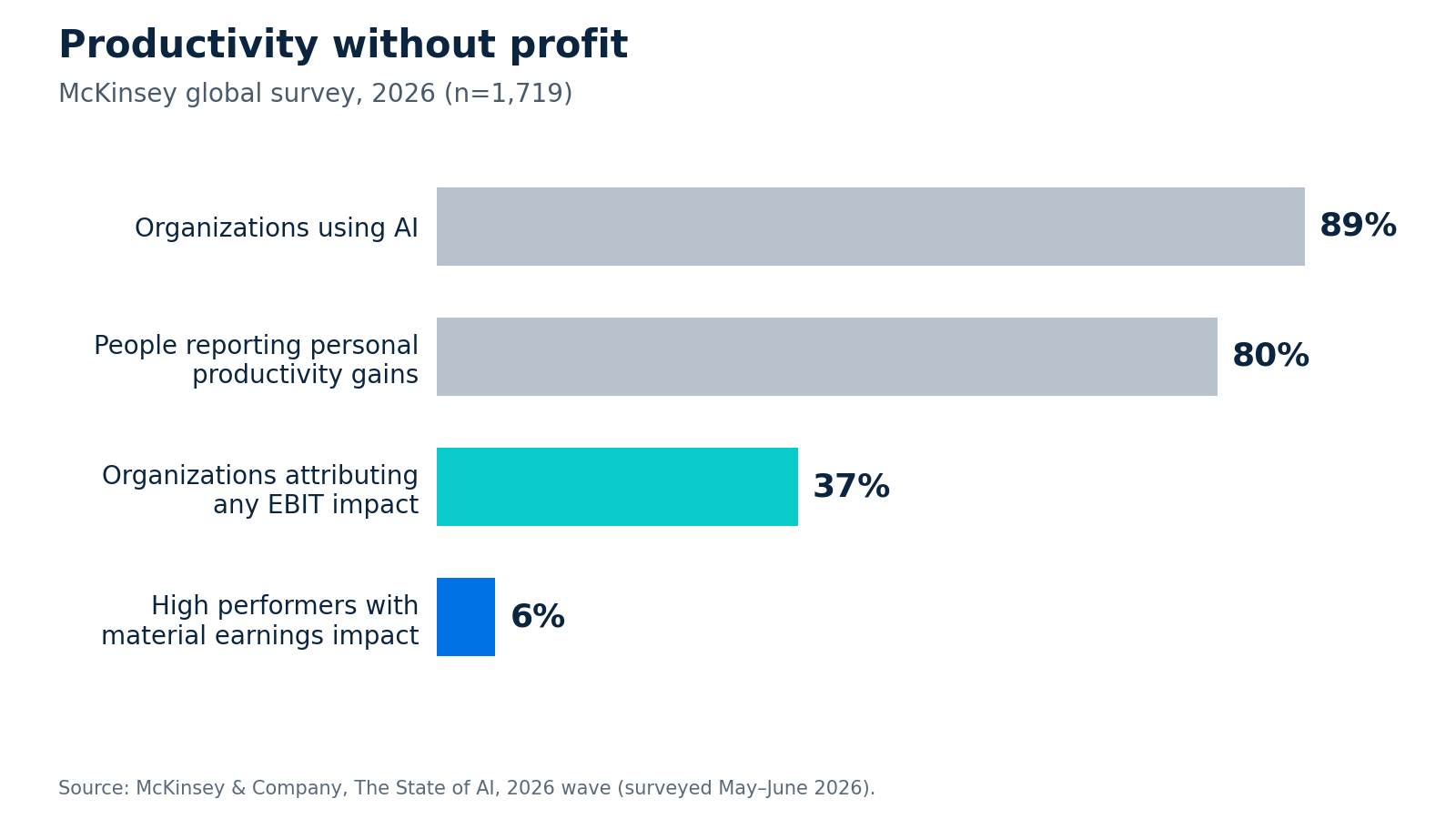
Productivity without profit
“Productivity without profit is the signature of a tool being used on the wrong problem.”
The collections industry should study that signature closely, because it is currently writing the largest technology cheques in its history.
What this means for issuers
Adoption rate is not a strategy. Before asking “which AI?”, ask “pointed at what?” That is the question the second paper in this series, “AI Is an Engine,” answers, and the one behind SymendConverse, conversational AI for collections steered by behavioural science rather than by deflection targets. For financial services and telecommunications teams evaluating vendors, Part 7 of this series sets out two questions to ask first.
The bottom line
AI adoption in collections is no longer the hard part; getting results from it is. The full paper, “AI Is an Engine,” carries the complete argument: the failure mode behind the numbers, the deterministic line no institution should cross, and why rising data barriers favour disciplined operators.
A 7-part series
The New Delinquency Playbook
Seven short posts drawn from two Symend research papers. The first, “The Averages Are Lying,” argues that consumer stress has become concentrated rather than widespread, that delinquency is a lagging indicator, and that credit scores have decoupled from behaviour, so issuers need to read behaviour early, re-segment on it, and move intervention upstream. The second, “AI Is an Engine,” argues that collections AI amplifies whatever operating philosophy it is given, so it only works when behavioural science steers it, outcome objectives replace deflection metrics, and credit decisions stay on the deterministic side of the line.
From “The Averages Are Lying”
- Part 1 of 7 Delinquency Is a Lagging Indicator The behaviour that predicts default shows up one to two years before the missed payment
- Part 2 of 7 The K-Shaped Consumer Why every aggregate dashboard is wrong about consumer stress
- Part 3 of 7 Same Score, Different Customer Credit scores have decoupled from behaviour — and treatment built on them shows it
- Part 4 of 7 The Prevention Curve The economics of acting before the roll
From “AI Is an Engine”
- Part 6 of 7 The Stigma Exception Most consumers dislike service AI. Debt may be different — if the engine is steered right
- Part 7 of 7 The Deterministic Line What AI must never decide in collections — and where it earns its keep
Frequently asked questions
How widely is AI used in collections?
Very widely. TransUnion’s industry survey found 93% of collections companies using or planning to use AI and machine learning, up from 49% in 2023.
Why do so many AI projects fail to deliver ROI?
They are often applied to existing processes and measured on productivity or cost per contact rather than outcomes. Productivity gains without profit suggest the tool is pointed at the wrong problem.
Where does the 95% AI failure figure come from?
An MIT NANDA report from August 2025 found 95% of enterprise generative-AI pilots produced no measurable P&L impact. Its methodology is contested, but other surveys point in the same direction.
How should collections teams measure AI success?
On outcomes: cure rates, roll rates, recovery and customer lifetime value, rather than conversations contained or calls avoided.
What should you ask before buying AI for collections?
What problem it is pointed at, what it is optimizing for, and where the vendor draws the line between deterministic decisions and generative conversation.
Endnotes
- Gartner, worldwide AI spending forecast, May 2026. Over 45% is infrastructure rather than applications.
- TransUnion, 7th annual Debt Collection Industry Report, published February 2026, via ACA International. “Using or planning to use” AI/ML: 93% (2025) vs. 49% (2023); voice 44%; negotiation support 42%; self-service 98%.
- Consumer Financial Protection Bureau, Chatbots in Consumer Finance, June 2023.
- MIT NANDA, The GenAI Divide: State of AI in Business 2025, August 2025. Methodology contested (failure defined as absence of rapid P&L impact); cited here with that caveat. Partnership-vs-internal success rates from the same report.
- S&P Global Market Intelligence (451 Research), March 2025 survey, n>1,000, North America and Europe.
- Gartner, June 2025 prediction on agentic-AI project cancellations by end-2027.
- Gartner, August 2024: 14% of customer-service issues fully resolved in self-service; July 2024: 64% of customers prefer companies not use AI for customer service, and 53% would consider switching to a competitor over it. General customer service, not collections-specific.
- McKinsey & Company, The State of AI (2026 wave; surveyed May–June 2026, n=1,719). 89% using AI; 37% attributing any EBIT impact (flat vs. 2025); 6% high performers; 80% reporting individual productivity gains. Same survey: 32% of organizations declined to buy software because agentic tools enabled in-house builds.


