
The Stigma Exception
Most consumers dislike service AI. Debt may be different — if the engine is steered right

The first paper in this series, “The Averages Are Lying,” argued that most delinquency is a cash-flow problem misread as a willingness problem, and that the behaviour predicting default is visible long before the missed payment. That argument matters here, because it describes the playbook most AI deployments are now automating.
Do consumers prefer AI or humans for debt conversations?
For debt, possibly AI. A 2026 study across eleven European countries found people reported less stigma discussing debt with an AI agent than with a human, 11% versus 19%, with trust nearly equal.⁵ Humans still rated higher on empathy and fairness, and the study is a preprint, so treat it as early evidence.
The failure mode: automating the old playbook
The most common failure mode in collections AI is precise: institutions are automating the playbook they already had. The same score-band waterfalls, the same escalating pressure sequences, the same contact-rate metrics, now executed by machines, at scale, around the clock. To the extent existing practice rests on incomplete assumptions about why customers fall behind, AI applied to it inherits the incompleteness and multiplies its output.
The first paper laid out the evidence: 94% of mortgage defaults trace to cash-flow shocks and life events, and 70% to cash flow alone; behavioural distress signals appear one to two years before delinquency; identical credit scores conceal opposite treatment responses.¹ A pressure-based playbook misreads that customer.
“An AI-accelerated pressure playbook misreads her thousands of times per hour, while reporting excellent efficiency metrics to its owners.”
The KPI regime does the damage
When conversational AI is bought as a labour-cost story, the system optimizes for deflection: conversations contained, calls avoided, headcount removed. The marquee forecast is precisely that story: Gartner’s 2022 call of $80 billion in contact-centre labour savings by 2026, still quoted, never trued up.²
Klarna became the emblem. Its AI assistant, Klarna said, did “the work of 700 agents.” Within eighteen months the company conceded the cost focus had produced lower-quality service and began rehiring humans, while keeping AI on two-thirds of its inquiries.³ The lesson is a rebalancing, and it is instructive: the failure was never the engine. The failure was the objective function handed to it.
Debt may be the exception to AI aversion
What makes this painful is that collections is one of the few domains where the consumer evidence favours well-designed AI. Consumers say they dislike AI in customer service generally: 64% would rather companies not use it, and more than half say they would consider switching over it.⁴
Debt appears to be the exception. In the eleven-country study, people reported markedly less stigma when a debt conversation was with an AI agent rather than a human, 11% versus 19%, with trust essentially equal (84% versus 85%).⁵ For a customer who is behind on a bill and ashamed of it, a capable, judgment-free digital counterpart is often the preferred one.
reported stigma in a debt conversation with an AI agent vs. a human, across eleven European countries.
Source: Academic preprint, February 2026
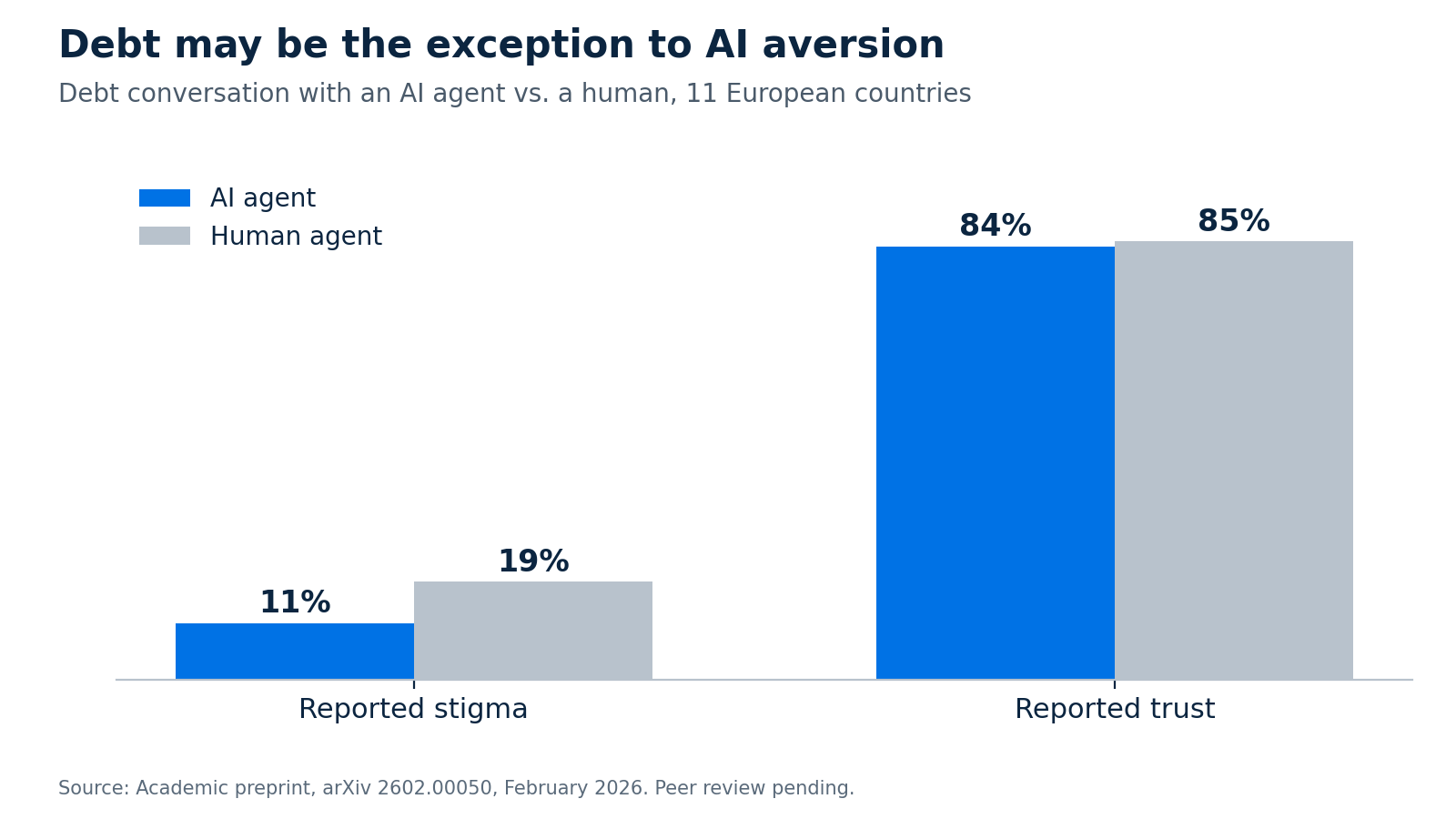
The dignity dividend looks real. It is squandered when the AI on the other end is running a dunning script.
What AI debt collection should optimize for
Audit what your AI is optimizing for. If the answer is deflection, containment or cost per contact, you have automated the broken playbook. The fix is to hand the engine outcome objectives, such as cure rates, roll rates and customer lifetime value, plus a behavioural model of the customer worth optimizing toward. That is the design principle behind SymendConverse, conversational AI for collections built on behavioural science, for financial services and telecommunications providers alike.
Symend’s program data shows what the alternative produces. At a major North American bank, roughly a tenth of the delinquent population stayed on legacy risk-based segmentation as a control, while the rest moved to behavioural segmentation derived from a supervised machine-learning model, not a generative system. Same channels, same operational footprint, different targeting logic. Cure rates rose from 70.2% to 75.1% on cards and from 52.3% to 57.9% on lines of credit, and the cycle-one roll rate fell from 21.5% to 19.4%. Results were validated as statistically significant.
The bottom line
Customers may welcome AI in the one conversation they least want to have with a person, but only if it is built to help them rather than to deflect them. The full paper, “AI Is an Engine,” carries the complete argument, including where the deterministic line sits and why the rising barriers around data are good news for disciplined operators.
A 7-part series
The New Delinquency Playbook
Seven short posts drawn from two Symend research papers. The first, “The Averages Are Lying,” argues that consumer stress has become concentrated rather than widespread, that delinquency is a lagging indicator, and that credit scores have decoupled from behaviour, so issuers need to read behaviour early, re-segment on it, and move intervention upstream. The second, “AI Is an Engine,” argues that collections AI amplifies whatever operating philosophy it is given, so it only works when behavioural science steers it, outcome objectives replace deflection metrics, and credit decisions stay on the deterministic side of the line.
From “The Averages Are Lying”
- Part 1 of 7 Delinquency Is a Lagging Indicator The behaviour that predicts default shows up one to two years before the missed payment
- Part 2 of 7 The K-Shaped Consumer Why every aggregate dashboard is wrong about consumer stress
- Part 3 of 7 Same Score, Different Customer Credit scores have decoupled from behaviour — and treatment built on them shows it
- Part 4 of 7 The Prevention Curve The economics of acting before the roll
From “AI Is an Engine”
- Part 5 of 7 The 95% Problem Collections is adopting AI faster than it is getting results
- Part 7 of 7 The Deterministic Line What AI must never decide in collections — and where it earns its keep
Frequently asked questions
Do customers prefer AI for debt collection conversations?
Early evidence suggests they might. A 2026 preprint across eleven European countries found lower reported stigma with an AI agent than with a human (11% vs. 19%), with trust nearly equal. Humans still rated higher on empathy and fairness.
Why do collections AI deployments fail?
Most automate the existing playbook and optimize for deflection or cost per contact. That multiplies the playbook’s flaws instead of fixing them.
What happened with Klarna’s AI customer service?
Klarna said its AI assistant did the work of 700 agents, then later acknowledged service quality had suffered and began rehiring humans, while keeping AI on about two-thirds of inquiries.
What should collections AI be optimized for?
Outcomes such as cure rates, roll rates and customer lifetime value, guided by a behavioural model of the customer, rather than containment or headcount reduction.
How is conversational AI for collections different from a general chatbot?
It is built for collections use cases and, in Symend’s case, tailors tone and tactics to each customer’s Delinquency Archetype rather than running one script for everyone.
Endnotes
- Ganong & Noel, Quarterly Journal of Economics 138(2), 2023 (94% cash-flow defaults); Bank of Canada Staff Analytical Paper 2026-3 (distress behaviour ~2 years before delinquency); Federal Reserve FEDS Notes, January 2024 (score migration). Full sourcing in Paper 1.
- Gartner, August 2022 forecast: conversational AI to reduce contact-centre agent labour costs by $80 billion in 2026.
- Customer Experience Dive and Forbes coverage of Klarna, 2024–May 2025. Klarna retained AI on roughly two-thirds of inquiries.
- Gartner, August 2024: 14% of customer-service issues fully resolved in self-service; July 2024: 64% of customers prefer companies not use AI for customer service, and 53% would consider switching to a competitor over it. General customer service, not collections-specific.
- Academic preprint (arXiv 2602.00050), published February 2026; eleven European countries, ages 18–70. Stigma probability 11% (AI contact) vs. 19% (human); trust 84% vs. 85%. Preprint — peer-review status pending.


